Francesca Woodman Archives

Francesca Woodman

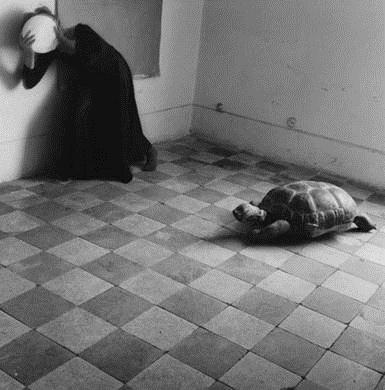
Francesca Woodman has become one of the most talked about, most studied and most influential of late twentieth-century photographers. She started taking photographs when she was barely thirteen, and in less than a decade, created a body of work that has now secured her a reputation as one of the most original American artists of the 1970s.

The figure of Woodman herself appears frequently in these exquisitely odd and unsettling photographs. In some of her photographs, her body seems to blend into the surroundings – caught in a state of metamorphosis – she is not quite here, nor quite there. In other images, she uses a variety of props to create strange and dreamlike tableaux, tinted with uncertainty, melancholy, and a sense of ethereal timelessness. Woodman committed suicide at the age of just 22, but in her brief yet extraordinary career, she created an enduring body of photographic work that continues to fascinate and influence today.

Joining us to examine this exhibition of silver gelatin prints is Florence Ingleby and Roberta McGrath. Florence Ingleby is Director of Ingleby Gallery and Roberta McGrath is Associate Lecturer in Photographic Theory and Criticism at Napier University, Edinburgh.

ARTIST ROOMS

This month we will be visiting the long-awaited ARTIST ROOMS exhibition at the Gallery of Modern Art to see the work of Vija Celmins, Ellen Gallagher, Damien Hirst, Alex Katz, Andy Warhol and Francesca Woodman.

ARTIST ROOMS is an extraordinary collection of international contemporary art recently acquired jointly by the National Galleries of Scotland and Tate through the donation of over 700 works from Anthony d’Offay which will tour a wide range of museums and galleries across the UK. At the heart of ARTIST ROOMS is the concept of individual rooms devoted to particular artists, so that their work can be seen and appreciated in depth.

Highlights of the exhibition on show at the Gallery of Modern Art include Celmin’s beautiful, delicate images of seas, deserts and the night sky; a complete series of landscape and portrait paintings by the American painter Alex Katz; Francesca Woodman’s intimate, surrealist-influenced photographs; and Damien Hirst’s iconic Away from the Flock – an early example of Hirst’s animals in formaldehyde.

Joining us to discuss the works will be Keith Hartley, Chief Curator at the Gallery of Modern Art. Keith was instrumental in negotiating with Anthony d’Offay to secure this important acquisition so it will be a fascinating insight into how it all came about.

Incommunicado

As promised, here is some more information about the upcoming Spin event in this impressive exhibition from the Hayward Gallery in London which opened here at the weekend. The Hayward blurb for the show is very illuminating, so I thought I would reproduce it here:

‘The desire to communicate can be a powerful motive behind the production of art, but it is the fallibility of communication that provides the subject for this exhibition.’

Curated by Margot Heller, Director of South London Gallery, Incommunicado brings together contemporary international film, video, photography, sculpture, drawing and text-based work to explore the manifestations and consequences of communication going wrong. The show examines personal misunderstandings, cultural and political clashes and linguistic and expressive limitations.

The importance of language in this context is introduced through work by Samuel Beckett, simultaneously signalling the writers influence on younger generations of visual artists. Central to the exhibition is Comedie (1966), a recently re-discovered film made in collaboration with Marin Karmitz, which reveals the poetic and absurd results of separating language from meaning. Other artists include: Pavel Buchler, Phil Coy, Omer Fast, Angus Fairhurst, Mona Hatoum, Christian Marclay, Bruce Nauman, Hirsch Perlman, Smith/Stewart, Erika Tan, Lawrence Weiner, Francesca Woodman and Chen Zhen.

You can probably tell from this that there will be elements of humour, absurdism, and poetry as well as a stimulating underlying theme to think about, and so it is highly appropriate (and gratifying) that we will have the artist John Beagles to help us negotiate it all! As well as being a lecturer in the Centre for Visual and Cultural Studies at Edinburgh College of Art, John works alongside Graham Ramsay in their art practice as the video/performance/installation art duo Beagles and Ramsay. They have had solo shows all over the place including Canada, Australia and the Netherlands, and are a very popular part of the contemporary scene in Scotland. You might have seen them last year at Zenomap, Scotland’s contribution to the Venice Biennale, the Stills Gallery or at the Collective Gallery.