27 June 2024
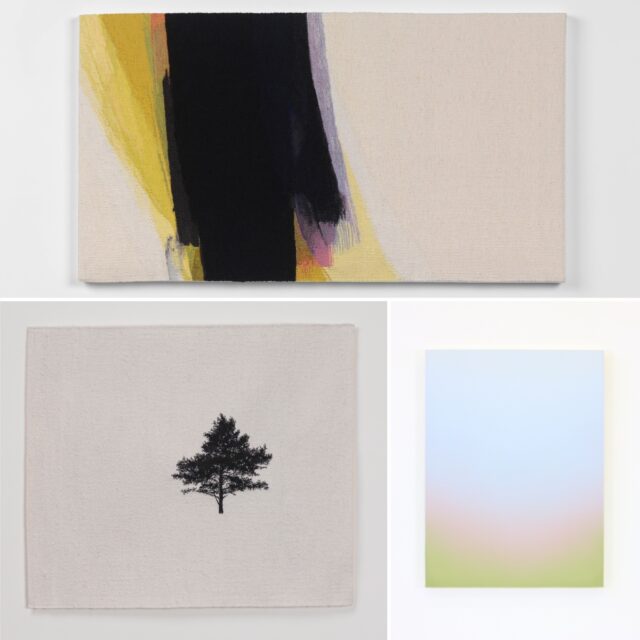
This month we will be heading to Wasps studios at Patriothall in Stockbridge to visit artists Jo Barker, Sara Brennan and Eric Cruickshank.
Some may remember Jo Baker from our Zoom session in January 2022, so it will be great for us to meet Jo in person. Her tapestry designs originate from simple gestural brush strokes in paint or ink with smudges of pastels. She is interested in our hands. In the spontaneous mark made by a simple gesture; traces of an event, a fleeting moment. The marks are then captured in the slow considered construction of tapestry weaving.
Sara Brennan‘s work is an unspoken response to landscape, with routes in a sense of place. Sara uses a refined and reduced approach to colour and form. Her work takes two routes, weaving either from her drawings or reacting and responding in smaller works to yarns as they are placed directly next to each other. The yarns are very specific and often unrepeatable.
Taking landscape as an initial starting point, Eric Cruikshank’s paintings are not about literal representation, instead the focus is on the emotive qualities of place. Using an objective palette tied to the Scottish landscape, colour acts as a vehicle to reveal the picture planes underlying points of reference; with the works being grounded in the everyday, the viewer is encouraged to readdress notions of their surroundings, where the familiar is opened up and made full of possibility.
26 May 2022
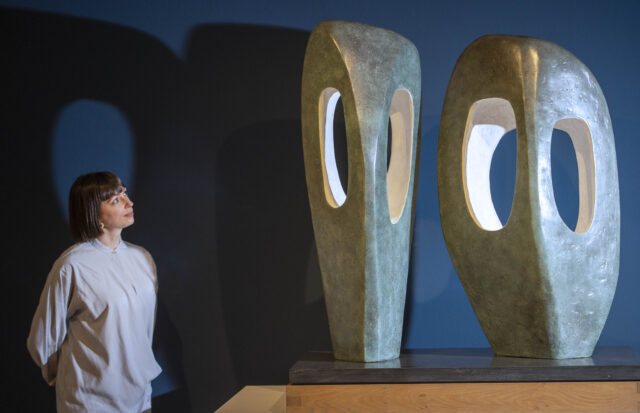
This month we will be making our way to the Scottish National Gallery of Modern Art to see Barbara Hepworth: Art & Life, where we will be joined by curator Leila Riszko.
Barbara Hepworth: Art & Life is a major retrospective, spanning the artist’s entire career charting the development of her practice, her engagement with political and societal change, and the events in her personal life which shaped her work. It features more than 120 works, lent from public and private collections, including renowned sculptures as well as rarely seen drawings and paintings.
The exhibition displays some of Hepworth’s most celebrated sculptures including the modern abstract carving that launched her career, her iconic strung sculptures, and later large-scale bronze and carved sculptures. It will also bring insight to Hepworth’s wide-ranging interests – such as dance, theatre, music, religion, politics, and science – and show how they infused her artistic practice.
Art & Life has been curated by Eleanor Clayton and organised by The Hepworth Wakefield in collaboration with the National Galleries of Scotland, and Tate St Ives.
18 July 2019
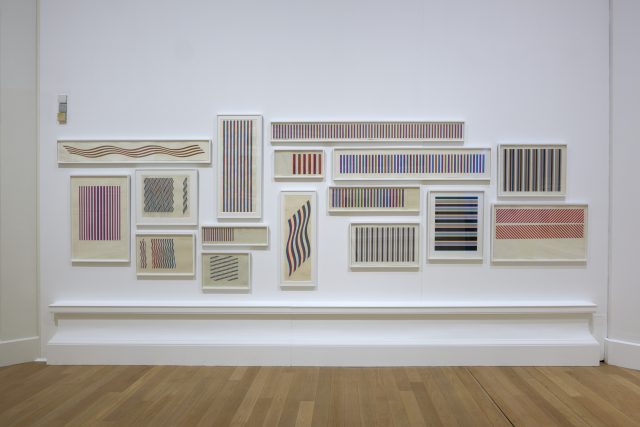
‘Looking is, I feel, a vital aspect of existence. Perception constitutes our awareness of what it is to be human, indeed what it is to be alive.’ Bridget Riley, 2019
Bridget Riley (b. 1931) is one of the most respected artists working in Britain today. Her remarkable career spans seventy years of uncompromising and remarkable innovation. Through her observations of the natural world, her experience of looking at the work of other artists, and through experimentation, Riley has made a deep, personal investigation of the act of painting and of how we see. In her abstract paintings, Riley generates dynamic energy, rhythm, movement, light and space, investigating the ways in which painting can engage their viewer.
The exhibition at the Royal Scottish Academy is the largest survey of Riley’s work to be held in Scotland. The exhibition places particular emphasis on the origins of Riley’s practice from her early experimentation with George Seurat’s ‘pointillism’ to the iconic black-and-white works of the 1960s to her expansive explorations into colour, wall paintings and recent works as well as studies that reveal Riley’s working methods.
We will be joined by Lucy Askew, Senior Curator at the Scottish National Gallery of Modern Art, who has worked very closely with Bridget Riley to realise this spectacular exhibition.
28 July 2011 at 6pm
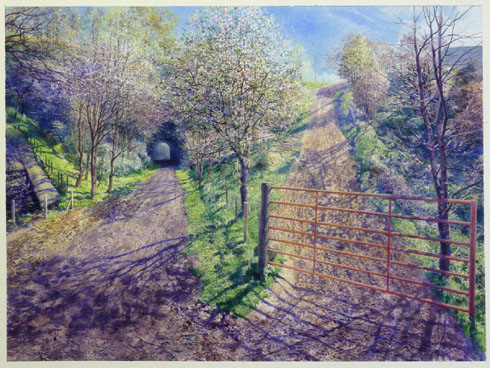
A visit to the studio spaces of David Forster and Michael Craik to discuss their current practice in contemporary painting.
David Forster’s landscapes refer to the traditions of the 18th and 19th centuries. Though the scenes depicted are topographically correct, Forster subtly alters the light and colour to create a fictionalised reality that conveys the authority of photorealist document. Whilst exploring the romantic narrative of landscape, Forster’s work presents the industrialised wilderness of farmland, the well-trodden solitude of the British uplands, and the tame sublime of the country park.
Michael Craik is fascinated by modernist architecture and creates abstract oil paintings which have been described as a ‘contemporary minimalism for an urban audience’. His most recent works focus on the geometry of squares or hexagons and are painted on aluminium panels to create works which evoke perspective and create a play of light which recalls the buildings from which the patterns have been drawn.
Patriothall Studios is parts of WASPS which has grown to become one of Scotlands largest arts organisations, providing studio space to over 750 artists each year at 17 locations throughout Scotland.
27 November 2008 at 6pm

Gerhard Richter is one of the most influential and important contemporary artists in the world today.
Drawn from a small, select number of private collections, this exhibition provides an unrivalled overview of the artist’s career from 1963 to the present. His paintings, both figurative and abstract, have had a huge impact on several generations of artists, and continue to do so, and has helped to make painting once again a vital means of artistic expression.
Richter’s incredibly complex work oscillates between paintings bordering on photorealism and large, abstract compositions of captivatingly expressive colour and technical perfection. Yet his work is always centred on painting itself, which is asserted in many different ways, confidently holding up its own reality for comparison to the actual world.
Joining us in discussion will be Keith Hartley, Chief Curator of the Gallery of Modern Art and curator of the Gerhard Richter exhibition.


