31 July 2025
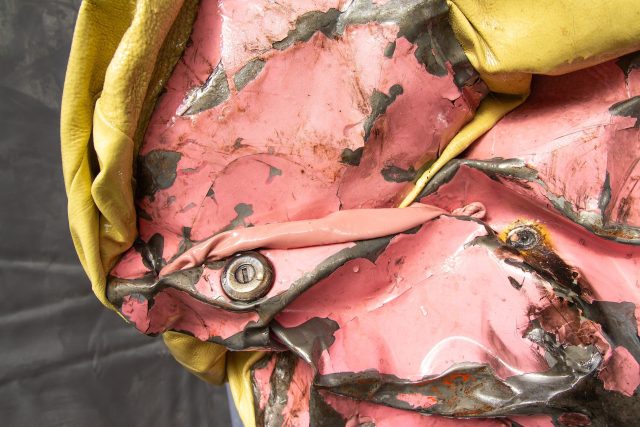
Join us and meet the artist Louise Gibson who will be unveiling her new works as commissioned by Edinburgh Sculpture Workshop, part of this year’s Edinburgh Art Festival.
Louise Gibson works with a combination of materials including resins, recycled fabrics and found objects. Her work is intuitive but measured in skills, utilising industrial processes with learned techniques, such as casting and car body lacquering. By combining polyester resins with found or scavenged materials, such as scaffolding netting or metal work, she creates impressive organic forms with complex finishes.
The exhibition will be held in the vast sculpture yard, an inspiring outdoor arena surrounded by
workshops and specialist machinery which provides a unique and a dynamic experience for us to explore Gibson’s work.
28 April 2022
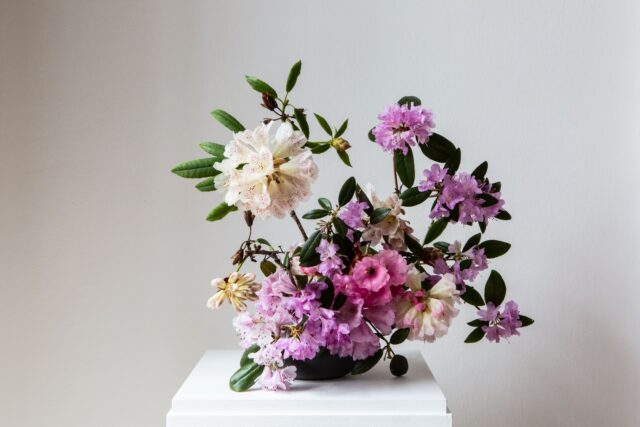
This month we will be making our way to Inverleith House to discuss their new exhibition Rhododendroms: Riddle, Obsession, Threat. We will be joined by Emma Nicolson, Head of Creative Programmes.
Coinciding with the peak flowering period of the Royal Botanic Garden Edinburgh’s rhododendrons, this exhibition reveals our significant history of collecting, researching and cultivating this genus.
Work by contemporary artists Simon Starling, Alison Turnbull and Yan Wang Preston is presented alongside historical botanical illustration, photography and objects from RBGE’s Archive. The exhibition also features newly commissioned work, Rhododatum: a collaboration between artists Stefanie Posavec and Ray Interactive, with RBGE Biodiversity Conservation Network Manager, Alan Elliott. This digital project brings to life RBGE’s expansive Rhododendron data sets and looks at contemporary concerns such as the IUCN’s Red List of Threatened Species and how that relates to our collections.
Rhododendrons: Riddle, Obsession, Threat is supported by Players of People’s Postcode Lottery and the Sibbald Trust. The exhibition sits within RBGE’s Climate House project, supported by Outset Contemporary Art Fund’s Transformative Grant.
24 November 2011 at 6pm
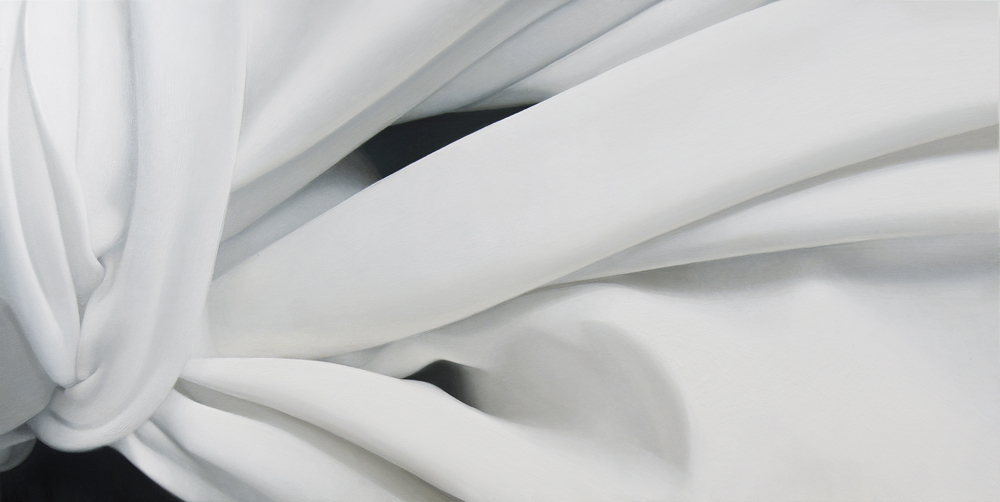
Hiding in Full View is a new series of paintings by Alison Watt in which she has been looking at the work of the American photographer Francesca Woodman (1958-98), taking indirect inspiration from the almost hypnotic imagery of Woodman’s intense and dreamlike tableaux.
In the spring of last year Alison Watt was commissioned by the Uffizi Gallery in Florence to make a work for their celebrated collection of self-portraits by women artists. This was an unusual commission, not least because it came nearly 15 years after Watt had last painted the human figure. Since relinquishing the figure in 1997, she has edged towards abstraction, painting swathes of fabric suggestive of both a human presence and absence. During her time spent at the Uffizi Gallery, Watt found herself looking closely at the photographs of Woodman, fascinated by the way that she used the object in her self portraits and how the two elements of self and object often merge.
If it was possible to create a painting that was difficult to identify and at the same time incredibly intimate, that was what I wanted to do – Alison Watt
Joining us in discussion will be Roberta McGrath who is Associate Lecturer in Photographic Theory and Criticism at Edinburgh Napier University. Roberta has published widely on the theory of the image and questions of representation, and has published “Seeing Her Sex: Medical Archives and the Female Body” (Manchester University Press, 2002) which focuses on issues of sexed subjectivity through visual representations of the reproductive female body made between 1750-1910.
28 October 2010 at 6pm
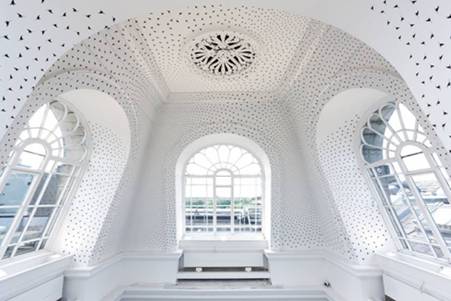
Our Spin event will be split over the two modern art galleries to see the work of Turner prize winner Richard Wright who was commissioned by The Scottish National Gallery of Modern Art to make a major wall-painting in one of the public stairwells of the Dean Gallery; and Part 3 of the rehang What you see is where you’re at featuring the work of Luke Fowler.
Glasgow-based artist Richard Wright is best known for painting on walls, where the context and architecture of the space are the content of the work. Believing that ‘there’s already too much stuff in the world’ Wright describes his work as having similar qualities to a musical performance in that it exists in the memory of the creator and the audience, but can’t be owned, sold, or carried around.
The title of the rehang What you see is where you’re at comes from the film on display by award winning Glasgow-based artist Luke Fowler. Fowler’s film documents and explores the Kingsley Hall social experiment carried out in the 60s by the Scottish psychiatrist and writer R. D. Laing and is part of his ongoing investigation into radical thinkers and those responsible for the development of progressive ideas.
We look forward to you joining us in discussion to uncover how the Dean building’s architecture, history and present function have all informed Richard Wright’s work and how the medium of film has provided Luke Fowler with the unique ability to facilitate access to such a sensitive subject. This will also be a chance for us to see some of the new contemporary works on display as part of the re-hang including Robert Therrien and Gilbert and George.
18 July 2009 at 9.15am

We are offering a Spin-off trip to the newly opened contemporary sculpture garden, Jupiter Artland, in the grounds of Bonnington House, just outside Edinburgh. Leading artists including Ian Hamilton Finlay, Andy Goldsworthy, Antony Gormley, Marc Quinn and Anish Kapoor, have been commissioned and have created work within the 80-acre estate of this Jacobean mansion.
Robert and Nicky Wilson bought Bonnington House in 1999. They soon realised the potential of the estates formal gardens, fields and woodlands as a perfect site for installing contemporary sculpture, fulfilling Nickys long-held ambition to create a sculpture garden. Strongly influenced by Ian Hamilton Finlay’s garden Little Sparta in Dunsyre, Jupiter Artland places art within the landscape.
The foundation has a charitable status with a strong commitment to produce educational resources for schools. They are also committed to nurturing the work of contemporary artists and will be offering an annual residency on an invitation basis. They will also continue to commission new site specific works.
The cost for the trip is £20 per person which includes entry to Jupiter Artland and a tour by their staff, Spin discussion and transport to and from the garden from the city centre. We will be hiring a mini bus which will leave the National Gallery of Scotland on the Mound at 9.15am and will drop people back in Edinburgh around 2pm.
25 March 2009 at 5.45pm
We have a special Spin evening this month with a visit to Dovecot Studios where we will be joined by artist Claire Barclay whose work we discussed at last month’s event at the Fruitmarket Gallery. Claire is one of many contemporary artists who have been invited to collaborate with the master weavers at Dovecot Studios. We will also be joined by David Weir, Director of Dovecot who will tell us more about the Studios and this exciting commission.
Dovecot Studios is home to Edinburgh’s innovative tapestry company. Established in 1912 by the 4th Marquess of Bute, Dovecot Studios founding weavers came from William Morris Merton Abby Workshops in Wimbledon, London. The studios were incorporated as The Edinburgh Tapestry Company in 1946, although they also continued to be known as Dovecot. Since its inception, the weavers have worked creatively with artists such as Frank Stella, Stanley Spencer, Frank Brangwyn, Henry Moore, Graham Sutherland, David Hockney, Eduardo Paolozzi, Alan Davie and more recently Barbara Rae and Elizabeth Blackadder, producing stunning tapestries for private commission and for public collections worldwide.
In August 2008, after an £8million refurbishment, Dovecot Studios moved to its new home in the former Victorian swimming baths on Infirmary Street. The main workshop reuses the main swimming pool area and the public viewing gallery retains the integrity of the original space. The weavers work regularly with artists, fashion designers and photographers to create new work in tapestry. The commission with Claire Barclay is particularly interesting due to Claire’s interest in process and making.
25 October 2007 at 6pm
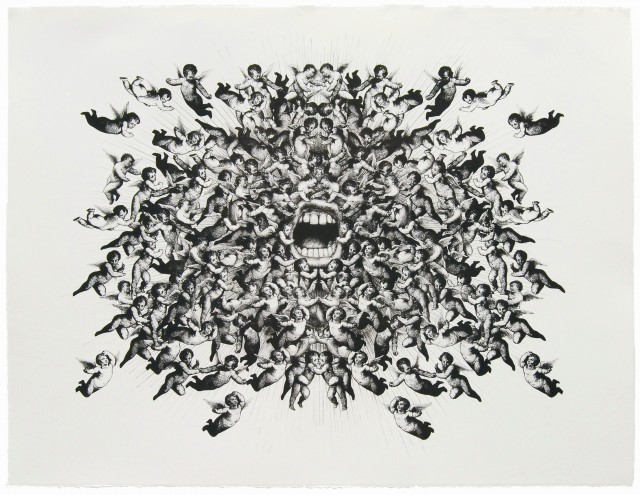
This month, we will visit Edinburgh Printmakers to see an exhibition of new commissions and 40 years of Printing at Edinburgh Printmakers Part 2 – 1987-2007 exhibition.
Edinburgh Printmakers regularly commissions contemporary artists across various artistic disciplines to collaborate on-site with master printmakers on the production of limited edition prints. This exhibition of new commissions ranges from the work of established artists to the newly emerging and recent graduates. Artists include David Shrigley, Toby Paterson, Gordon Robin Brown and Jessica Harrison.
Joining us will be Alastair Clark and Michelle Berry who will take us behind the scenes for a tour of the artist studios before discussing the exhibiting prints and artists.
Alastair Clark is a practicing artist and Assistant Director of the Printmakers. Michelle Berry is a practicing artist and is the Audience Development and Education Officer at Edinburgh Printmakers.
27 November 2003 at 6pm
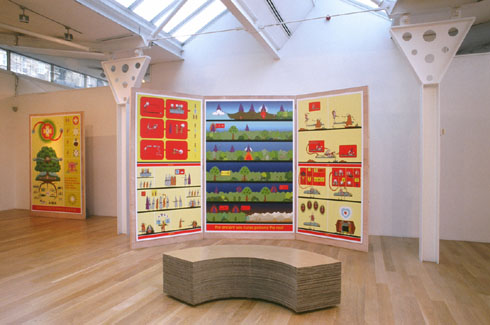
To mark the culmination of the gallery’s acclaimed four-year series VISIONS FOR THE FUTURE with the presentation of work by Edinburgh-based artists Paul Carter and Chad McCail, we will be hearing from Gallery exhibitions manager, George Gilliland. He will present an overview of the new commissions series and its publications and then give us a tour of Carter and McCail’s installations.
Both artists are held in great affection by Edinburgh audiences who have enjoyed watching their work develop since their initial impact on the scene a few years ago. Although their approaches are highly individual and distinct, they both have a gift for the uncanny. They recast familiar things in a strange light – their imaginary worlds are spooky and wondrous at the same time.
Chad McCail’s exhibition, Life is driven by the desire for pleasure, features intricate large-format cartoon diagrams, revealing the pleasure-seeking principle underlying cycles of life, work and relationships.
Paul Carter’s Edge of Darkness adopts the language of old-fashioned museum display. His dioramas of objects and artefacts illustrate forgotten or illusory geographical conquests in a re-imagined uncharted Scotland. Carter’s imagery of the intrepid ‘solo’ expedition holds human populations at a distance, in contrast to McCail’s collective image of humanity, which draws all things into the social network.


