Tag Archives: conceptual art

Jean-Marc Bustamante – Dead Calm

This month we will be looking at the work of Jean-Marc Bustamante, one of France’s senior artists and a major figure in the international art world.

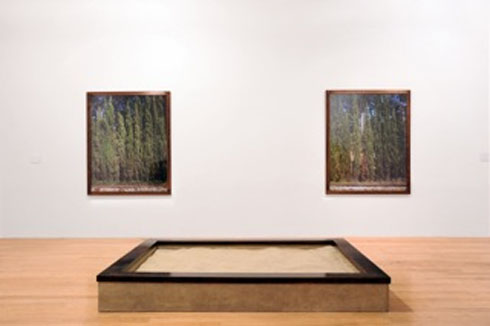
Bustamante received critical acclaim with his contribution to the French pavilion at the Venice Biennial in 2003. A key theme in his work is a linking of what Uta Grosenick has called the abstract space of the mind with the real space of nature and architecture. Though sitting outside recognisable trends in recent art, Bustamante’s work has a formal and conceptual contemporaneity, a freshness, that makes it relevant to the way art is made and looked at today. His clear, direct vision manifests itself in an almost bewildering array of materials and media – first photography, then sculpture, painting, architectural projects and installation. His work is unified and characterised by its calm intelligence and a kind of extraordinary ordinariness that helps us see its subject, the world around us, in a new way.

This exhibition includes classic work from the 1980s and 1990s – the large-scale photographs and sculptures with which Bustamante made his name and more recent works from 2000 onwards, in particular a series of paintings on Plexiglas made especially for The Fruitmarket Gallery and completed in 2010.

Joining us to explore how Bustamante continuously reinvents his ideas and artistic language will be Stacy Boldrick – Research and Interpretation Manager at The Fruitmarket Gallery.
Robert Barry

A visit to the acclaimed New York artist Robert Barry’s exhibition, Words and Music at the Common Guild.

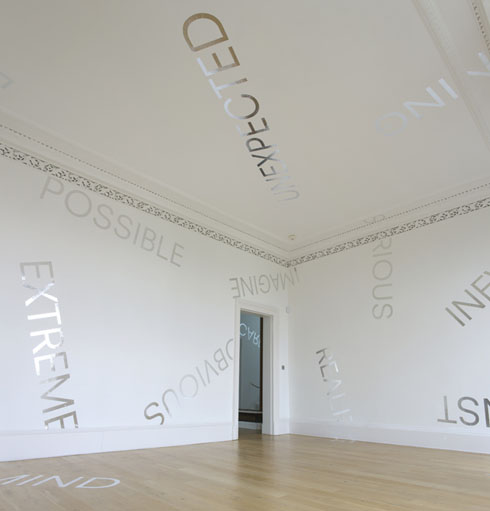
This exhibition comprises a new installation conceived specially for The Common Guild by one of the most influential American artists associated with the emergence of conceptual art in the late 1960 and early 1970s. Robert Barry was a pioneer of conceptual art, abandoning painting in 1967 to produce site-specific installations, many of which were almost invisible to the viewer. These installations and actions relied on language to indicate their existence, shifting the presentation and reception of the work from image to text.

Since the early 1970s, language, or perhaps more correctly, words, have been central to Barry’s practice, which has since included typewriter drawings, wall pieces, slide projections and films as well as often cited actions such as gas releases and telepathic pieces. Barry is now perhaps best known for his large-scale text installations known as word spaces, which cast a selection of words in a given space from an ongoing and ever-changing collection.

Applied directly to the walls, windows and floors of the gallery, the words surround the viewer, reasserting the importance of the viewer at the heart of the art experience. As Barry explains, ‘Instead of trying to use text to convey an idea or meaning, I became interested in the individual power of the word to convey emotions or feelings.’

Although utterly conceptual in origin, Robert Barry’s work is essentially experiential. This rare opportunity to see his work brings the physical space between the words, the gallery and the viewer into focus.

Richard Long: Walking and Marking

This time last year, a gathering of artists, curators, friends and family assembled in Greyfriars Kirk to honour one of Scotland’s most important conceptual artists, Ian Hamilton Findlay. His son, Alec Finlay, related his father’s principals to Heraclitus’ philosophy that you can never step into the same river twice. It could be suggested that this is the impetus of all great Land Artists, including Richard Long, who also refers to this belief throughout his work.

As a graduate from the influential St Martins College of Art in London during the late sixties, Richard Long stood alongside Hamish Fulton, Gilbert & George and Roger Ackling, as an artist who would completely alter our perception of art practice.

Whether Long is on a six-day walk through Torridon, kayaking down the Colombia River or working in Warli Tribal Land in Maharahtra, India, he works with the most immediate materials that are available to him to make his art. Using mud, water, sticks and stones, he forms them into elemental shapes such as lines, circles and spirals, to express, in a visually arresting way, his presence within the landscape.

Since Long makes art directly in the landscape, much of his work takes the form of photographs, maps and text pieces, however for the exhibition at the SNGMA, he has created Cornish Slate Cross 2007 in the grounds of the Gallery of Modern Art and mud drawings made from mud from the Firth of Forth.

This is a great opportunity to view 40 years of work in Long’s first retrospective in Britain since 1991.

Douglas Gordon: Superhumanatural

‘I provide the board, the pieces and the dice, but you are the ones that have to play.

Douglas Gordon

We will be visiting the much-anticipated retrospective exhibition by Douglas Gordon, one of Scotland’s most celebrated contemporary artists. And it doesnt disappoint.

The Royal Scottish Academy Building has been transformed beyond recognition with specially constructed blacked-out spaces, TV monitors and installations where the familiar becomes unfamiliar. Superhumanatural is Gordon’s first retrospective exhibition to be held in Scotland and features key works including 24 Hour Psycho (1993), Through a Looking Glass (1999) and 30 Seconds Text (1996).

Born in Glasgow in 1966, Douglas Gordon was among a number of Glasgow-based artists who embraced a more conceptually-orientated art in the 1990s. His deployment of pre-existing material, most notably in his use of Hitchcock’s iconic film in his work 24 Hour Psycho, attracted particular attention. He won the Turner Prize in 1996, the Premio 2000 at the Venice Biennale in 1997 and the Hugo Boss Prize at the Guggenheim Museum, New York in 1998. Earlier this year, he had a mid-career survey exhibition at the Museum of Modern Art in New York.

Working in video, film, photography, audio and text-based works, he explores themes of trust, guilt, confession, deception and doubling. Many of his works are based on dichotomies – good and evil, life and death, birth and death, perception and memory and seduction and violence.

This is a great opportunity to see a major exhibition of his work. We will be joined by Keith Hartley, curator of the exhibition and Chief Curator and Deputy to the Director at the Scottish National Gallery of Modern Art. Keith, who was the exhibition curator, has been working on the show for a few years and will be able to provide us with a fascinating insight into the works and the man himself.