16 February 2011 at 6.30pm
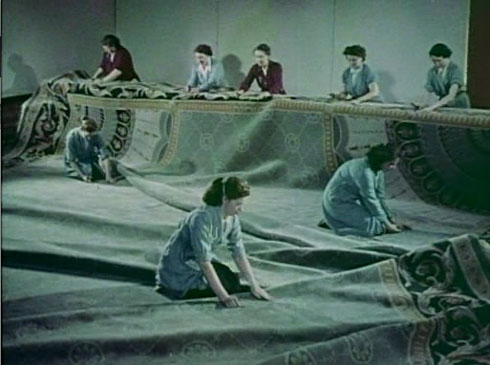
A chance to learn about the work of the collective PANEL and visit their current show, The Innovators of Tradition.
The Inventors of Tradition is an exhibition, film screening and publication conceived by Beca Lipscombe and Lucy McKenzie (Atelier) and Panel, in partnership with the Scottish Screen Archive at National Library of Scotland and exhibition designers Martha.
At the intersection between art, design and social history, The Inventors of Tradition is a subjective study of the history of the Scottish textiles industry since the 1930s. It brings together samples of world-class design, the archive material of individuals and companies and a series of short documentary films sourced from the Scottish Screen Archive. In response to this material, the artist Lucy McKenzie and designer Beca Lipscombe, have produced a series of new works including clothing, furniture, painting and accessories.
Atelier’s new collection has been produced in collaboration with Begg Scotland, Caerlee Mills, Hawick Cashmere, Mackintosh, Muehlbauer, Janette Murray, Steven Purvis and Elizabeth Radcliffe.
Panel is led by design curators, Catriona Duffy and Lucy McEachan. Based in Glasgow, Panel promotes design and craft locally and internationally through exhibitions, events and cultural projects. By animating spaces beyond the gallery, the organisation is committed to creating environments that give audiences and designers the opportunity to engage with design and craft in imaginative and experiential ways. It also collaborates with a network of creative individuals and organisations, nationally and internationally, providing a unique and creative approach to curating and producing exhibitions and events, project development and management.
26 February 2009 at 6.15pm
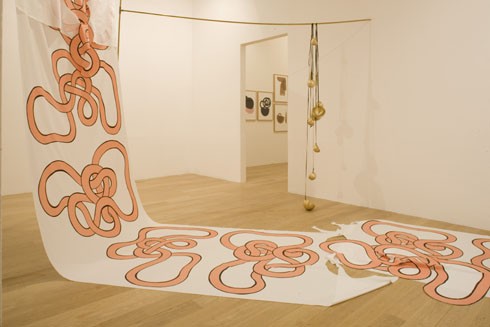
This month we will be visiting The Fruitmarket Gallery to see a solo exhibition of work by Scottish artist Claire Barclay, known for work which takes the form of highly crafted sculptural objects brought together into precisely plotted relationships. Featuring newly commissioned work shown in the context of objects made over the course of her career, the exhibition offers an opportunity to trace the development of the artist’s singular sculptural language.
Barclay encourages us to engage with her work on a profoundly instinctual level. We think we recognise familiar objects, like keys, pots or combs, but all have been shaped in such a way as to prevent any practical use. Tables defy gravity to stand on three legs, while chairs have neither a seat nor a back. Unable to attribute meaning through function, we are led instead on an associative journey triggered by memory and the imagination that draws on the sensory and the subconscious as well as the demands of reason.
Biography: Claire Barclay was born in 1968 in Paisley and currently lives and works in Glasgow. She graduated from the Environmental Art and Sculpture Course at Glasgow School of Art in 1990 and completed an MFA in Glasgow in 1993. In 2003, she represented Scotland at the Venice Bienniale alongside Simon Starling and Jim Lambie. She is represented by doggerfisher, Edinburgh.
24 April 2008 at 6pm
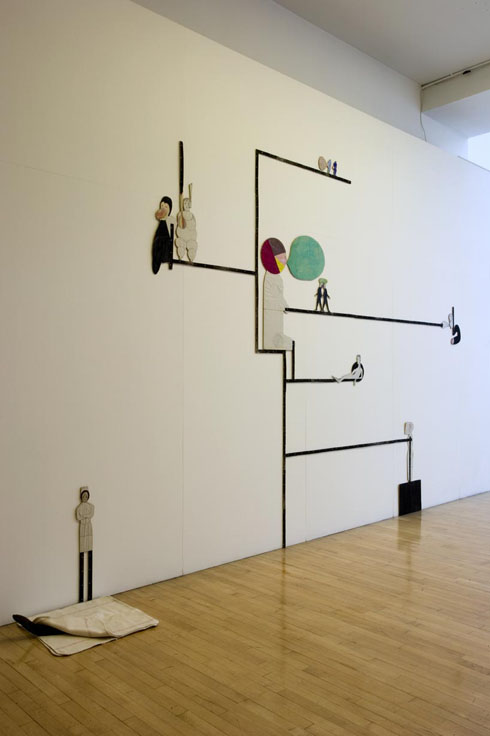
Enrico David first came to attention in 1999 with a series of large-scale, embroidered canvases, exhibited in the group exhibition New Labour at the Saatchi Gallery. Always using drawing as a backbone but also borrowing from traditional craft techniques and stylistic design, David employs these with mischief, playfulness and a certain knowing crudeness: setting before us a cast of characters in theatrical situations and mock stage sets. Sources of inspiration include 1920’s Picasso and design styles such as Italian Carnivalesque and Art Deco.
Central to the exhibition is the work that bears its title. Ultra Paste is a re-imagined facsimile of the artist’s childhood bedroom. Taking his inspiration from a 1935 photo-collage by artist Dora Maar, we see a teenage Enrico engaged in a perverse embrace with a generic anatomical mannequin. Other works range from objects and photographs to large canvases and installation.
Joining us to explore these bizarre, and sometimes disturbing, exhibits, will be Zoe Fothergill – Curator, Education and Development of Talbot Rice.
24 July 2005
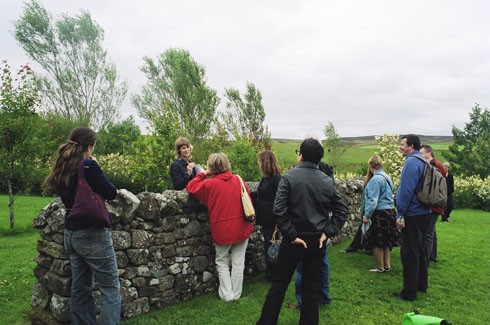
The sun is shining, the days are long; every now and then, there is the distant sound of police and protestors clashing. It is an appropriately surreal and extreme time to head to Little Sparta. The idyllic sculpture garden, surrounding a wee croft in the southern uplands of Scotland, is studded with references to the philosophical values of the French Revolution and the techniques of modern warfare. It still resonates with the noises of the Little Spartan War 1983 (the Follies War and the French War were to follow later). Finlay clashed with Strathclyde Region over its bureaucratic bungling of a rates dispute; and the sheriff officer and his men staged two raids on the Finlay’s Garden Temple. Although they were repelled by Finlay’s supporters (the Saint-Just Vigilantes) in the first battle, the sheriff and his men succeeded in seizing several works in the second onslaught. Nor was Finlay mellowed by experience – he went on to have further fights ‘on principle’ with the National Trust for Scotland and the French Ministry of Culture, as well as half of the people he ever worked with.
Ian Hamilton Finlay‘s uncompromising commitment to ‘beauty’ and classical rigour may not have won friends, but it did produce the most uniquely distinctive and challenging body of work in Scotland in the last century. Finlay is a concrete poet first and foremost, and has been a prolific collaborator with many different artists, craftspeople and poets with whom he has created an extensive collection of sculptures, prints and books. His public art works are to be found in cities all over the world and many of his works will be on display in three co-ordinated exhibitions in Edinburgh over the summer: at the Ingleby Gallery, Inverleith House and the Scottish Poetry Library. But there is no doubt that the heart and soul of Ian Hamilton Finlay’s work will always be the garden at Little Sparta.
Spin members were invited to join an exclusive bus trip to the garden, to uncover the complex threads and hedonistic delights of Finlay’s work.


