28 November 2024

This month we will be joined by assistant curator Leila Riszko, as she guides us around the new exhibition Bruce McLean: I Want My Crown at Modern One.
This celebratory display of works by internationally renowned Scottish artist Bruce McLean, marks his 80th birthday. Discover McLean’s humorous and lively six-decade long inquiry into sculpture and his criticisms of the art world from within. Through works made across a range of media – including photography, performance, painting, printmaking, film, and ceramics – this display invites you to challenge your thinking about sculpture and expand your ideas of what it can be.
Sharp, witty and satirical, this display will showcase the breadth of McLean’s boundary-pushing work and spotlight him as one of the most important artists of his generation.
31 October 2024

pass shadow, whisper shade brings together new work by the six participants in the 2024 Satellites Programme: Clarinda Tse, Emelia Kerr Beale, Hannan Jones, Josie KO, Katherine Fay Allan and Rowan Markson.
The title borrows from an Irish proverb, ‘Ar scáth a chéile a mhaireann na daoine’, roughly translating as ‘people live in each other’s shadows’, or, ‘we rely on each other for shelter.’ Both a shade and a shadow, this kind of shelter encompasses the positive and negative aspects of being part of a community, living in the shadow of each other and our ancestors.
Across a range of distinctive and individual practices and media, the works signal something of the complexity of inheritance, raising questions of how we process and make sense of that which we inherit, the expansive multiplicity of legacies passed down by and through earlier generations.
25 July 2024

This month we will be joined by Chief Curator Lucy Askew as we make our way to Modern Two for Women in Revolt! Art and Activism in the UK 1970-1990.
This touring exhibition is a timely exploration of the work and lived experiences of a post-war generation of women artists that have largely been omitted from art historical narratives. Surfacing the wealth and diversity of work created in the UK during the 1970s and 80s, a period of seismic social and political change, it demonstrates, across a wide variety of mediums including painting, drawing, sculpture, performance, film and photography, how women’s needs were marginalised within mainstream culture and reveals how these artists used radical ideas and methods to confront issues that will resonate with contemporary audiences – from access to healthcare and class struggles to ecological disaster, racism, and misogyny.
28 September 2023
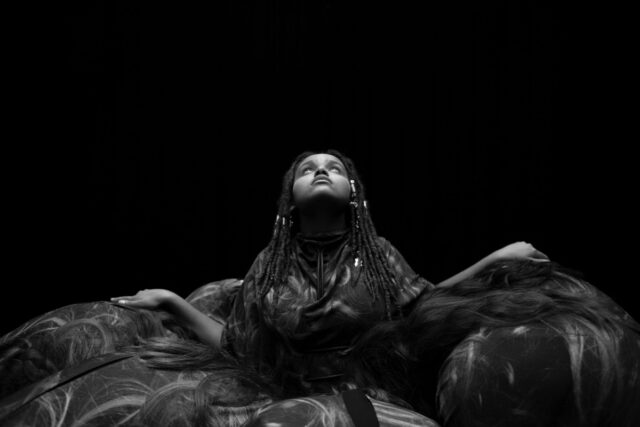
This month head to the Talbot Rice Gallery for three new exhibitions on show by artists Lawrence Abu Hamdan, Hephzibah Israel and Jesse Jones.
Lawrence Abu Hamdan’s new film commission, 45th Parallel, focuses on the Haskell Free Library and Opera House, a unique municipal site that straddles the jurisdictions of Canada and the United States.
Commissioned by Talbot Rice Gallery and produced in collaboration with Fraser Muggeridge studio, மொழிபெயர்ப்பு / the nature of difference is a series of twenty individual text works by Hephzibah Israel that poetically explores the nature of translation and what it is to navigate borders.
Jesse Jones’ new film installation The Tower is the second part in a trilogy beginning with Tremble Tremble, which was commissioned for the Irish Pavilion at the 57th Venice Biennale in 2017.
24 November 2022
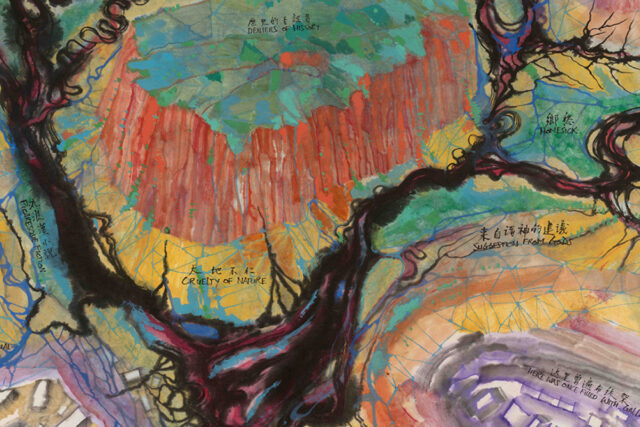
This month we will be returning to the Talbot Rice Gallery for their new show Qiu Zhijie| Lara Favaretto| Nira Pereg, where we will be joined by curator James Clegg.
In the historic Georgian Gallery, Qiu Zhijie presents his first major UK exhibition, including a body of map-paintings informed by remote sensing technology. In the White Gallery, Lara Favaretto’s Momentary Monument takes the form of a monolithic library that will disperse over the course of the exhibition, and upstairs, Nira Pereg’s film installations document a site shared by both Jewish and Muslim worshippers in the city of Al-Khalil/Hebron, Occupied Palestinian Territory.
The works of these three artists reflect on the idea of the monument. Fictional, momentary and paradoxical, their distinct approaches to the concept of ‘”something that reminds” act against the heavy material monuments that proliferate around the world, to describe a more momentary, imaginary or contested space. Sometimes contradictory, sometimes policed, and always characterised by disappearance, these distinct exhibitions reflect upon the fragility of our communion with the past.
31 March 2022
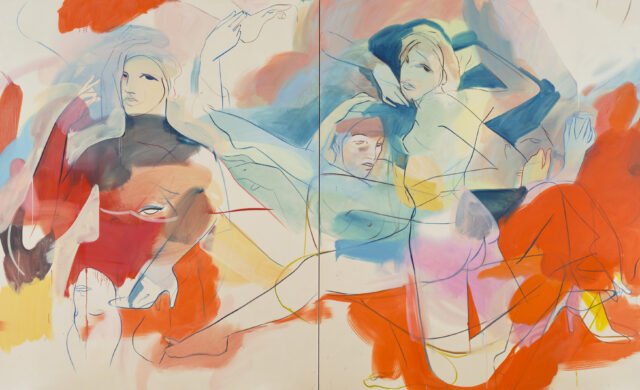
This month we are visiting New Arrivals: from Salvador Dalí to Jenny Saville at the Scottish National Gallery of Modern Art. Joining us for the evening will be Emma Gillespie. Emma has worked in a number of roles at the National Galleries of Scotland since 2014 and was appointed Assistant Curator of Modern and Contemporary Art in 2019.
New Arrivals presents a fascinating showcase of the most recent acquisitions at the Scottish National Gallery of Modern Art. Featuring over 100 works of art, many of which are being shown here for the first time since they entered the collection, and spanning 110 years of art-making, the show offers a stunning range of modern and contemporary work including painting, sculptures, films and more.
Exhibition highlights include pieces by many historical and contemporary greats: Marc Chagall (the first painting by him to join a public collection in Scotland), Damien Hirst, Wangechi Mutu, Pablo Picasso, Bridget Riley, Jenny Saville, and Alberta Whittle, amongst many others. The show also spotlights a number of significant additions to National Galleries of Scotland’s world-renowned Surrealist collection, notably several works by female Surrealists, including Leonora Carrington and Dorothea Tanning.
29 November 2018

This month we invite you to see Tremble Tremble by Jessie Jones, the Irish representation at the 2017 Venice Biennale, installed in the Talbot Rice Gallery. We will be joined by assistant curator James Clegg who will introduce the exhibition.
Approaching modern gender politics through a dramatic aesthetic, Jesse Jones’ piece evokes a multitude of associations, cultural links and triggers. For the making of this work, Jones drew from recognisable political references, such as the very title. Tremble Tremble references the 1970s Italian women’s protest of the same name, which called for wages for housework. Referring to the medieval prosecution of witches and also to the historic Repeal the 8th movement in Ireland this summer, she has created a layered and dense visual narrative which sits somewhere between theatre, film and sculpture.
The group exhibition At the Gates is shown alongside Jones’ work and consists of work by fellow women artists exploring feminism, self-empowerment and current social and political events. Often brushing up against the law, or institutions of power, these artists and their projects demonstrate the impact art can have when it becomes part of a public discussion.
26 April 2018

For the last 15 years, Scotland + Venice has been providing artists based in Scotland with a valuable platform to showcase their work on the international stage at one of the world’s most prestigious visual arts festivals, the Venice Biennale. Previous artists have included Graham Fagen, Karla Black and Martin Boyce.
For the 57th edition of the Venice Biennale in 2017, the selected artist was Rachel Maclean. A graduate of Edinburgh College of Art, Maclean makes films using green screen technology to create outlandish characters and fantasy worlds in which she explores politics, society and identity. Spite Your Face was written when Donald Trump had just won the Presidential election and in the aftermath of the EU Referendum and explores, amongst other things, notions of truth. The basis of the narrative in which Maclean plays all the parts, is the classic Italian folktale, The Adventures of Pinocchio.
This is the UK premiere the work which was originally commissioned by Talbot Rice Gallery ad Alchemy Film and Arts for Scotland + Venice. We will be joined by Stuart Fallon, Assistant Curator at the Gallery who worked closely on the project.
30 November 2017

This month, we will be exploring the work of the acclaimed artist and filmmaker, John Akomfrah. Vertigo Sea (2015) is a three-screen film installation that draws together archival footage, literary sources and newly shot footage, weaving together narratives of slavery, whaling and the current refugee crisis. Initially prompted by a radio interview with a group of young Nigerian migrants who had survived an illegal crossing of the Mediterranean, it expresses the vast beauty and cruelty of the sea. Vertigo Sea was filmed in Skye, the Faroes, Norway with the BBC Natural History Unit and at its core are two remarkable books: Herman Melville’s Moby-Dick (1851) and Heathcote Williams’ epic poem, Whale Nation (1988). Vertigo Sea was one of the standout works at the Venice Biennale in 2015.
Also on show is a video and sound installation – At the Graveside of Tarkovsky (2012) – a meditation on disappearance, memory and death and an ode to the Russian director Andrei Tarkovsky who inspired Akomfrah as a young filmmaker.
26 October 2017

This month, we will be exploring the work of two contemporary artists – Graham Fagen and Douglas Gordon – who have made work in response to the poet Robert Burns (1759-1796).
First shown at the 2015 Venice Biennale, Graham Fagen’s The Slave’s Lament is centred on the 1792 Robert Burns song of the same name as well as drawing our attention to an episode in Burns’ life. In 1786, Burns books a passage to Jamaica to escape economic problems with the aim of becoming a book-keeper on a slave plantation. At the very last moment, news that his recently published first book of poems has been well received changes his mind. In 1792, he pens The Slave’s Lament, his only work that empathises with the suffering of the displaced, the trafficked and the enslaved.
The centrepiece of the installation is The Slave’s Lament, a 4-channel video work in which classical composer Sally Beamish has created an extraordinary interpretation of Burns’ work. Performed by musicians from the Scottish Ensemble, music producer Adrian Sherwood, and the reggae singer and musician Ghetto Priest, it is a chilling reminder that Burns might once have become involved in the very suffering that inspired the lament.
In the Great Hall of the Portrait Gallery stands John Flaxman’s famous 1824 marble statue of Robert Burns. Originally housed in Thomas Hamilton’s Greek revivalist Burns Monument to the south of Edinburgh’s Calton Hill, the sculpture occupies pride of place in the gallery. In a specially commissioned installation, Turner-Prize winner Douglas Gordon confronts this monument to Burns by creating a full-sized replica in black marble, smashed into pieces, lying on the floor. Gordon has long explored the divided psyche in his work and seeing Burns fallen from his pedestal, dark and flawed, the inner man is revealed.
‘With Black Burns, I don’t know if it’s a shattered portrait of a man or a portrait of a shattered man.’ Douglas Gordon.
Joining us to discuss both works will be Susanna Beaumont, a curator, mentor and advisor and founder director of doggerfisher (2000-2010).


