Tag Archives: Ian Hamilton Finlay

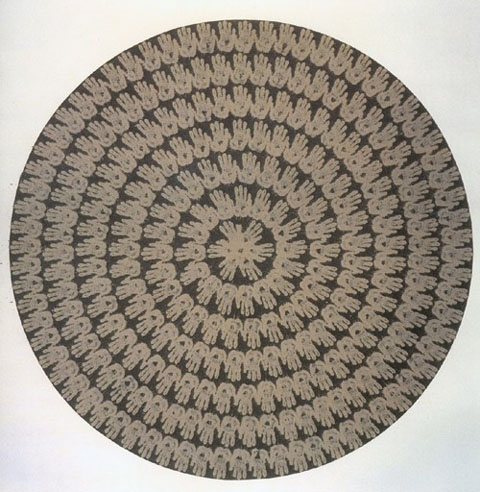
Richard Long: Walking and Marking

This time last year, a gathering of artists, curators, friends and family assembled in Greyfriars Kirk to honour one of Scotland’s most important conceptual artists, Ian Hamilton Findlay. His son, Alec Finlay, related his father’s principals to Heraclitus’ philosophy that you can never step into the same river twice. It could be suggested that this is the impetus of all great Land Artists, including Richard Long, who also refers to this belief throughout his work.

As a graduate from the influential St Martins College of Art in London during the late sixties, Richard Long stood alongside Hamish Fulton, Gilbert & George and Roger Ackling, as an artist who would completely alter our perception of art practice.

Whether Long is on a six-day walk through Torridon, kayaking down the Colombia River or working in Warli Tribal Land in Maharahtra, India, he works with the most immediate materials that are available to him to make his art. Using mud, water, sticks and stones, he forms them into elemental shapes such as lines, circles and spirals, to express, in a visually arresting way, his presence within the landscape.

Since Long makes art directly in the landscape, much of his work takes the form of photographs, maps and text pieces, however for the exhibition at the SNGMA, he has created Cornish Slate Cross 2007 in the grounds of the Gallery of Modern Art and mud drawings made from mud from the Firth of Forth.

This is a great opportunity to view 40 years of work in Long’s first retrospective in Britain since 1991.
Spin-Off Trip to Little Sparta

The sun is shining, the days are long; every now and then, there is the distant sound of police and protestors clashing. It is an appropriately surreal and extreme time to head to Little Sparta. The idyllic sculpture garden, surrounding a wee croft in the southern uplands of Scotland, is studded with references to the philosophical values of the French Revolution and the techniques of modern warfare. It still resonates with the noises of the Little Spartan War 1983 (the Follies War and the French War were to follow later). Finlay clashed with Strathclyde Region over its bureaucratic bungling of a rates dispute; and the sheriff officer and his men staged two raids on the Finlay’s Garden Temple. Although they were repelled by Finlay’s supporters (the Saint-Just Vigilantes) in the first battle, the sheriff and his men succeeded in seizing several works in the second onslaught. Nor was Finlay mellowed by experience – he went on to have further fights ‘on principle’ with the National Trust for Scotland and the French Ministry of Culture, as well as half of the people he ever worked with.

Ian Hamilton Finlay‘s uncompromising commitment to ‘beauty’ and classical rigour may not have won friends, but it did produce the most uniquely distinctive and challenging body of work in Scotland in the last century. Finlay is a concrete poet first and foremost, and has been a prolific collaborator with many different artists, craftspeople and poets with whom he has created an extensive collection of sculptures, prints and books. His public art works are to be found in cities all over the world and many of his works will be on display in three co-ordinated exhibitions in Edinburgh over the summer: at the Ingleby Gallery, Inverleith House and the Scottish Poetry Library. But there is no doubt that the heart and soul of Ian Hamilton Finlay’s work will always be the garden at Little Sparta.

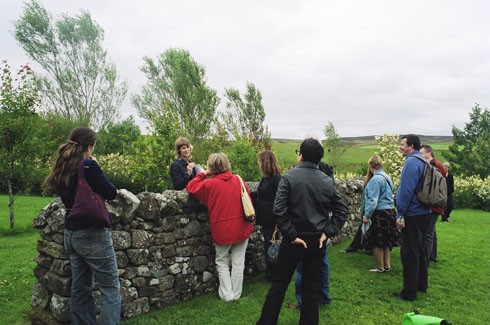
Spin members were invited to join an exclusive bus trip to the garden, to uncover the complex threads and hedonistic delights of Finlay’s work.