Tag Archives: Ingleby Gallery

Kevin Harman: No Man’s Land

For our April Spin event we will visit and discuss the exhibition Kevin Harman: No Man’s Land at the Ingleby Gallery, where we will be joined by the visual arts specialist and consultant Wendy Law, who has worked closely with Kevin on various projects. This will be the last chance to visit Ingleby in their current location, as the Gallery will be moving to a new site in the near future.

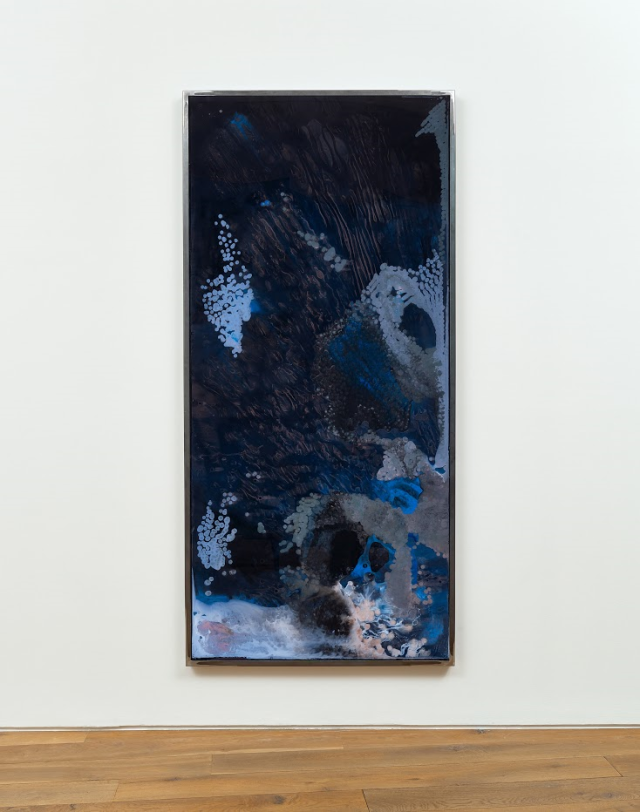
Some of you will remember visiting Kevin’s studio in October 2014 to discuss the installations and performances he was working on at the time. No Man’s Land presents his most recent work: a series of wall-hanging, abstract ‘glassworks’ produced over the last two years. These pieces are made by pouring paint into double-glazing units, resulting in layered and dripped effects that are as much the result of chance as of the artist’s intention. These painting/objects challenge the notion that the painting offers a ‘window on the world’. They also echo the free use of paint by earlier generations of artists from the atmospheric watercolours of J.M.W. Turner to the surrealist paint techniques used by Max Ernst and the bold abstract expressionist gestures of Jackson Pollock. Kevin Harman’s work offers a rich stimulus for discussion.
Garry Fabian Miller: The Middle Place

Our June Spin event will be at the Ingleby Gallery where we will be discussing Garry Fabian Miller’s exhibition The Middle Place.

We will be joined for the discussion by David Brittain who has been involved with photography as a critic, curator, editor and documentary maker. Between 1991-2001, he was Editor of Creative Camera magazine and is presently Research Assistant/Senior Lecturer in Photography at Manchester Metropolitan University. He is the author of the forthcoming book, Paolozzi at New Worlds: Science Fiction and Pop Art in the Sixties.

 This exhibition presents a series of new abstract works by Bristol-based artist Garry Fabian Miller, alongside a very early series of seascapes made in 1976 now known as Sections of England: The Sea Horizon. In the 37 years since these images were made, the horizon has continued to be one of Miller’s central preoccupations.

Alongside the Sea Horizon images, Ingleby Gallery will also exhibit a group of new, large format, camera-less works titled The Middle Place which explore the territory which Miller describes as ‘…the meeting of earth and sky. The horizon offering the possibility of understanding our place within the world and its purpose.’

Fabian Miller’s camera-less work was featured in the 2010 Shadow Catchers exhibition at the V&A.

Alison Watt: Hiding in Full View

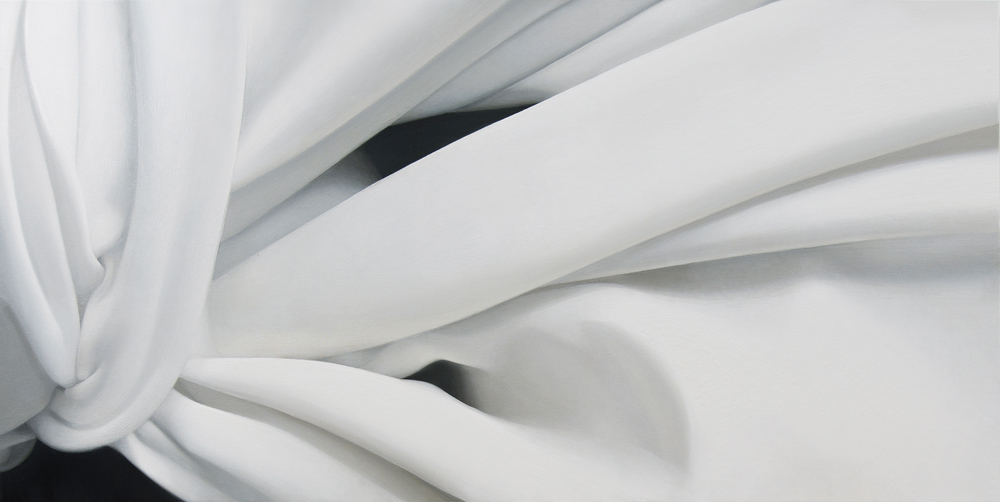
Hiding in Full View is a new series of paintings by Alison Watt in which she has been looking at the work of the American photographer Francesca Woodman (1958-98), taking indirect inspiration from the almost hypnotic imagery of Woodman’s intense and dreamlike tableaux.

In the spring of last year Alison Watt was commissioned by the Uffizi Gallery in Florence to make a work for their celebrated collection of self-portraits by women artists. This was an unusual commission, not least because it came nearly 15 years after Watt had last painted the human figure. Since relinquishing the figure in 1997, she has edged towards abstraction, painting swathes of fabric suggestive of both a human presence and absence. During her time spent at the Uffizi Gallery, Watt found herself looking closely at the photographs of Woodman, fascinated by the way that she used the object in her self portraits and how the two elements of self and object often merge.

If it was possible to create a painting that was difficult to identify and at the same time incredibly intimate, that was what I wanted to do  – Alison Watt

Joining us in discussion will be Roberta McGrath who is Associate Lecturer in Photographic Theory and Criticism at Edinburgh Napier University. Roberta has published widely on the theory of the image and questions of representation, and has published “Seeing Her Sex: Medical Archives and the Female Body” (Manchester University Press, 2002) which focuses on issues of sexed subjectivity through visual representations of the reproductive female body made between 1750-1910.

Peter Liversidge – The Thrill of it All

This month, we will be joined by the artist Peter Liversidge to discuss his recently opened exhibition The Thrill of it All. Some of you will remember seeing Peter’s work – Signpost to Jupiter – during our Spin-off trip to Jupiter Artland in 2009.

Any exhibition of work by Peter Liversidge is predicted to present the unpredictable. For more than a decade, Liversidge’s work has encompassed every medium creating paintings and drawings, photograhy, performance and sculpture. The tone of his work shifts from the playful to the poignant, but is always underpinned by a generosity that unifies and characterises his distinct and varied approach.

Given the uncertainty that a Liversidge exhibition presents, every element in an exhibition of his work begins at the artist’s kitchen table with Liversidge sitting alone writing proposals on an old manual typewriter. These hand-typed pages, present an array of possible and impossible ideas for performances and artworks in almost every conceivable medium. In a sense, the first realisation of every work is in Liversidge’s head, then on the page, then in the mind of the reader, and finally as a physical object or happening.

This will be a chance for us to explore the ideas that underpin Peter’s practice and to discover what role we play within his creative process.

Dark Light by Alison Watt

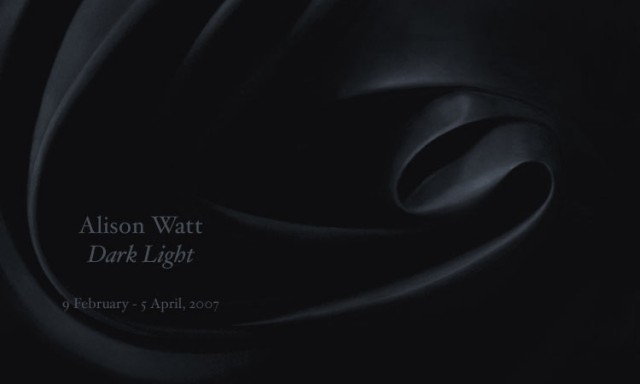
Dark Light is ‘a painting that can literally be stepped into’. Scottish painter Alison Watt, who is currently artist-in-residence at the National Gallery in London, has created a room within a room in the form of a metal cube. Step inside and eloquent paintings of black cloth are revealed.

In previous solo exhibitions, namely Fold at the Fruitmarket Gallery in 1997, Watt presented diptychs of fabric and figure. Three years later in Shift at the Scottish National Gallery of Modern Art, only the fabric and the suggestion of a human form remained. In 2004, she created Still, a composite of four 6ft paintings suspended in the Memorial Chapel of Old St Pauls Church. This personal homage to this extraordinary space was one of the highlights of the Edinburgh Festival of 2004, and is now on permanent display.

As Watt’s paintings have become increasingly engulfing and abstract, Dark Light is the fruits of her ambition to create an installation piece, made as a result of her Creative Scotland Award.

We will be looking at this exciting new work and will also consider the shift from figurative painting to abstraction which is ever prominent in contemporary art, as well as focusing on the relationship between the dealer and the artist.

Garry Fabian Miller

‘The pictures I make are of nothing which exists in the world . . . What I am trying to suggest is a state of mind which lifts the spirits and gives strength and some kind of clarity.’

Garry Fabian Miller, 2003

Garry Fabian Miller was born in Bristol in 1957. Much of his early work was landscape-based and focused on the horizon between the sky and land or sea. Since 1985, he has been producing optically mesmerising photographic works without the use of a camera or film. Instead he works directly with light, using techniques pioneered in the 19th century by William Henry Fox Talbot.

All his works are made by passing light through objects, or through filters of oil or coloured water, onto photo-sensitive paper. Its a simple, semi-controlled process, but one that constantly surprises.

The images Miller creates are essentially abstract, but there is a certain familiarity about them. They can represent a moment when day is either beginning or ending – a quality of light that we have all witnessed.

For his third exhibition at the Ingleby Gallery, the artist presents his most recent series of works Exposure, made in response to time spent on the Hebridean Island of Tiree. He first visited this remote community in 1974 as a teenager when he made his very first photographs.

Garry Fabian Miller is one of the most progressive artists working with photography today. His work has been the subject of a major exhibition at the Rencontres dArles, Europes major festival of photography in the south of France. A 256-page monograph on his work, Illumine, was published earlier in the year by Merrell.

The Ingleby Gallery has also published a book, Exposure, to accompany the exhibition.

We will be talking to Caroline Broadhurst, Gallery Manager at the Ingleby Gallery, about this incredible body of new work.

Spin-Off Trip – FIELDTRIP!

Spin members were invited to an exclusive tour organised by Spin, the Contemporary Art Society and their associates, Blood, to address the wider context of collecting for institutions. The tour coincided with the Contemporary Art Society’s ShowCASe exhibition featuring over 100 works which have been acquired on behalf of the CAS in the last five years, ready for donation to galleries and museums across the country. On show at the City Art Centre and the Talbot Rice, this was the only complete showing of this group of works before it was dispersed to new homes throughout the UK.

FIELDTRIP! included a tour of the contemporary art collection in the new Scottish Parliament, in the company of two parliamentarians involved in commissioning work, Eric Kinsey and Dr John Gibbon, and art critic Moira Jeffrey, whose documentary about the process was aired on television recently. This was followed by a visit to ShowCASe with CAS curator Ceri Lewis and then attendance at the ‘ShowCASing Craft’ talk with Amanda Game, craft curator at the Scottish Gallery.

Finally, there was an exclusive screening of the National Galleries of Scotland’s first video commission, a work by Daniel Warren. Part two of the tour introduced some of Edinburgh’s cutting-edge spaces, together with curators and artists that drive the contemporary art scene in Edinburgh. These included Inverleith House, Ingleby Gallery, Collective Gallery and the Embassy Gallery.

Susan Derges

This will be our first visit to the wonderful Ingleby Gallery. Its owners Richard and Florence Ingleby have created a serene suite of exhibition rooms on the ground floor of their town house in Carlton Terrace, retaining elements of the rooms’ domestic character as a setting for the display of modernist and contemporary art. On Thursday, Richard will introduce us to the gallery and its ethos, and also discuss the current exhibition of work by Susan Derges.

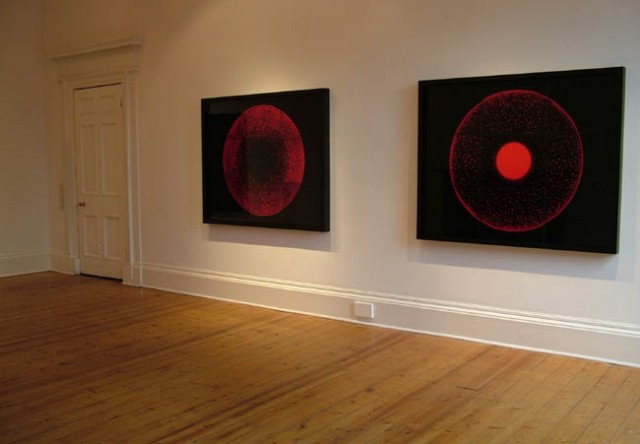
Derges is renowned for her cameraless images, ‘exposed’ outdoors – usually in the delicate light of night-time – and developed in situ, using the natural world as a dark room. Her images are immediate and beautiful, but they are also more complex than they may seem at first. Derges continues to invent new techniques and languages for photography and this exhibition is an opportunity to see her most recent experiments.