18 July 2019
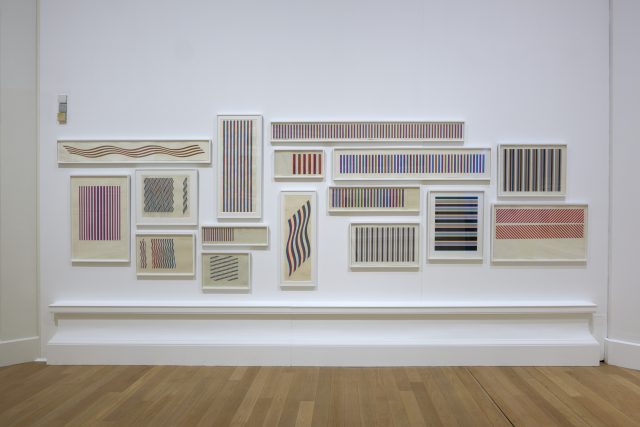
‘Looking is, I feel, a vital aspect of existence. Perception constitutes our awareness of what it is to be human, indeed what it is to be alive.’ Bridget Riley, 2019
Bridget Riley (b. 1931) is one of the most respected artists working in Britain today. Her remarkable career spans seventy years of uncompromising and remarkable innovation. Through her observations of the natural world, her experience of looking at the work of other artists, and through experimentation, Riley has made a deep, personal investigation of the act of painting and of how we see. In her abstract paintings, Riley generates dynamic energy, rhythm, movement, light and space, investigating the ways in which painting can engage their viewer.
The exhibition at the Royal Scottish Academy is the largest survey of Riley’s work to be held in Scotland. The exhibition places particular emphasis on the origins of Riley’s practice from her early experimentation with George Seurat’s ‘pointillism’ to the iconic black-and-white works of the 1960s to her expansive explorations into colour, wall paintings and recent works as well as studies that reveal Riley’s working methods.
We will be joined by Lucy Askew, Senior Curator at the Scottish National Gallery of Modern Art, who has worked very closely with Bridget Riley to realise this spectacular exhibition.
31 May 2018

Raqib Shaw is one of the most extraordinary and sought-after artists working in the world today. Born in Kolkata in 1974 and raised in Kashmir, he came to study in London in 1998 and has lived there ever since.
Shaw is known for his intricately detailed and richly coloured enamel paintings of fantastical worlds, inspired by Old Master paintings whilst drawing on an eclectic range of sources from mythology and religion, literature, autobiography, textiles and decorative arts from both eastern and western traditions, all infused with the artist’s imagination.
Equally fascinating is how these works are created. Together with a team of assistants, he spends months on preparatory drawings, tracings and photographic studies. The composition is then transferred onto prepared wooden panels establishing an intricate design with an acrylic liner. He then adds the enamel paint using needle-fine syringes and a porcupine quill.
We will be joined by Patrick Elliott, curator of the exhibition and Chief Curator at the Gallery of Modern Art who will provide an invaluable insight into Raqib’s work and the artist himself.
29 March 2018
We’re back at the Gallery of Modern Art to discuss the third instalment of NOW, a series of exhibitions which highlight the range of quality of work being made by artists associated with Scotland and across the globe.
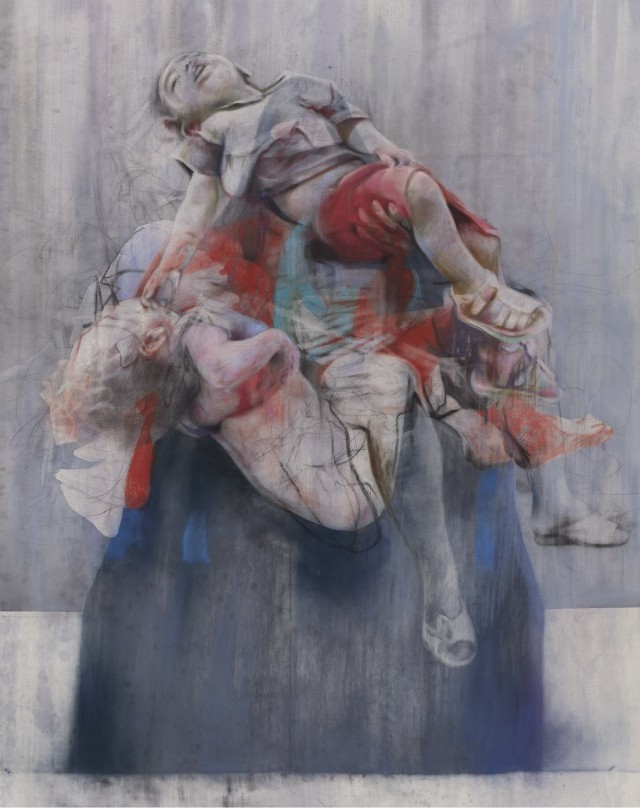
At the heart of the exhibition is five rooms dedicated to British artist Jenny Saville. She is best known for her monumental paintings of the naked female body which she first developed for her graduation exhibition at Glasgow School of Art in 1992. It was during this time that she came to the attention of Charles Saatchi who commissioned Saville to create 15 new works which were later displayed at the Saatchi Gallery.
On show will be paintings and drawings spanning her 25-year career including a new acquisition for the collection – Study for Branded 1992. More recently, Saville has been working with charcoal and pastel in which she layers imagery to suggest movement. She draws from a range of sources including art of the past, graffiti, children’s drawings and ancient myths.
We will be concentrating on Jenny’s work for this session and will be joined by artist Karen Strang, who also studied at Glasgow School of Art, to discuss the work.
27 April 2017
NOW is the first in a series of exhibitions which brings together contemporary art from Scotland with works by leading international artists. Over the next three years, through a series of six exhibitions, NOW will explore and celebrate the role of artists in society and the alternative ways of seeing and understanding the world through their work.
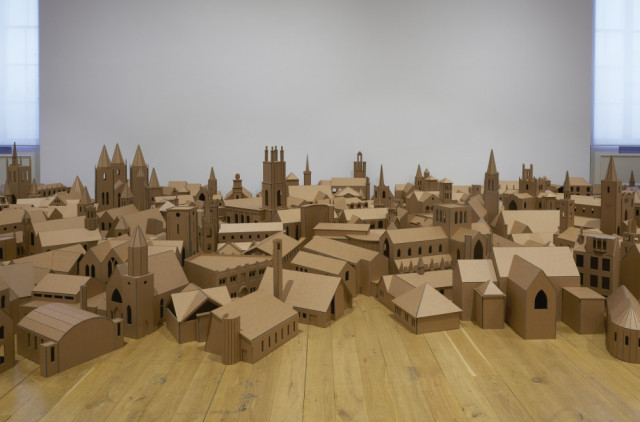
The centerpiece of the first show is Nathan Coley’s The Lamp of Sacrifice, 286 Places of Worship, Edinburgh, 2004. This iconic work features 286 sculptures which depict every place of worship listed in the 2004 edition of the Edinburgh Yellow Pages directory, offering a snapshot of the city at a particular moment in time through its places of religious meeting.
A key theme running through the exhibition is place and its relationship to time. Peter Doig’s imagined landscape is shown with Jock McFadyen’s real landscape of Carlton Hill recalled from memory. Rivane Neuenschwander’s Colheita Harvest 2013-2014 is a portrait of a London community through an installation of 365 shopping lists collected from supermarkets.
Performance Documents 1980-1987/2013 by Mona Hatoum presents rare archival material documenting the actions and performances she produced during the 1980s. And The Acrobat c.1982 by Peter Horobin, documents performances and interventions he did whilst on a month-long residency in Kassel under the persona of The Acrobat.
Joining us to discuss the works on show will be the curators of the exhibition, Lucy Askew and Julie-Ann Delaney.
30 March 2017

This month we are heading to The Fruitmarket Gallery to explore and discuss the work of Mark Wallinger. This is a two-part exhibition, shown at the Fruitmarket and the DCA in Dundee.
Mark Wallinger has been making art and exhibiting since the 1980s. You may be familiar with his piece, Ecce Homo, a marble resin life-sized statue of Jesus Christ which became the first sculpture to be mounted on the empty plinth in Trafalgar Square in 1999. His Turner Prize-winning installation of 2007, State Britain, was a painstaking recreation of Brian Haw’s anti-war peace camp in Parliament Square.
For his new exhibition, Wallinger presents his id Paintings (2015-16), a recent body of monumental paintings made entirely by the artist’s hands and black acrylic paint. Part-painting, part-performance, he used both hands simultaneously, the left mirroring the right. Also on show, will be his ‘I’ self-portrait paintings, continuing his on-going fascination with self-portraiture. In addition, there will be a selection of works from the last 10 or so years including the film Sleeper (2004).
28 April 2016
For our April Spin event we will visit and discuss the exhibition Kevin Harman: No Man’s Land at the Ingleby Gallery, where we will be joined by the visual arts specialist and consultant Wendy Law, who has worked closely with Kevin on various projects. This will be the last chance to visit Ingleby in their current location, as the Gallery will be moving to a new site in the near future.
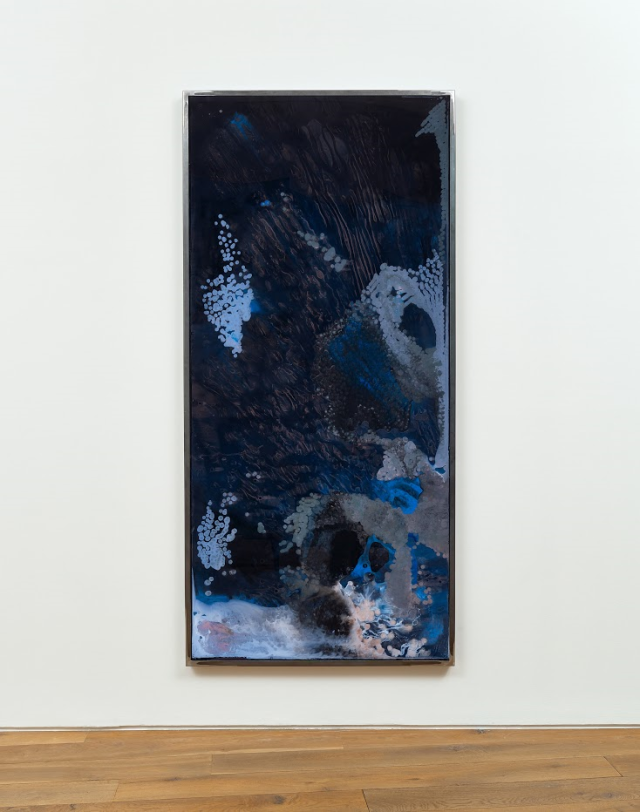
Some of you will remember visiting Kevin’s studio in October 2014 to discuss the installations and performances he was working on at the time. No Man’s Land presents his most recent work: a series of wall-hanging, abstract ‘glassworks’ produced over the last two years. These pieces are made by pouring paint into double-glazing units, resulting in layered and dripped effects that are as much the result of chance as of the artist’s intention. These painting/objects challenge the notion that the painting offers a ‘window on the world’. They also echo the free use of paint by earlier generations of artists from the atmospheric watercolours of J.M.W. Turner to the surrealist paint techniques used by Max Ernst and the bold abstract expressionist gestures of Jackson Pollock. Kevin Harman’s work offers a rich stimulus for discussion.
27 November 2014
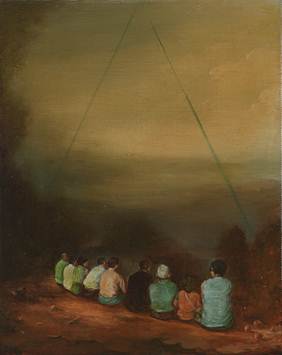
For our November Spin event, we will be visiting Christopher Orr’s The Beguiled Eye exhibition at the Talbot Rice Gallery.
Orr’s oil paintings and watercolours offer enigmatic glimpses into other worlds where modern characters appear within expansive environments, laden with drama. These small paintings suggest narratives far beyond their scale.
The intriguing scenes derive from an appropriation of images from a vast range of visual materials, including National Geographic magazines, scientific manuals, 1950s snaps, art historical images and Super 8 films. Orr’s use of delicately rendered characters against more expressive backdrops, borrows from the vocabulary of Old Master painting.
This is his first solo show in Scotland which brings together new and recent paintings including, for the first time, a display of the artist’s remarkable sketchbooks.
24 October 2013, 6-7.30pm
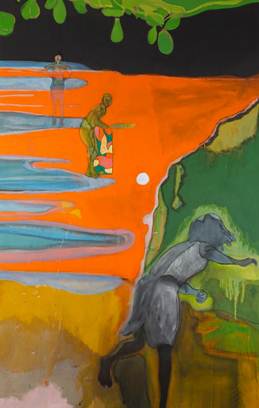
Peter Doig No Foreign Lands was one of the highlights of this year’s Edinburgh Art Festival. We will be joined by the exhibition’s co-curator, Julie-Ann Delany, Curator at the Scottish National Gallery of Modern Art, to discuss this major exhibition of paintings by one of the most internationally-renowned artists.
Over a career of nearly three decades, Peter Doig has reinvigorated the medium of painting. His inventive style, sensuous palette and suggestive imagery set him apart from the conceptualism dominating much of contemporary art. A willingness to take up the challenge still posed by the paintings of Gauguin, Matisse, Bonnard and Edward Hopper places him in a long line of great colourists, expressive handlers of paint and creators of richly textured worlds.
This is Doig’s first major exhibition in the country of his birth and showcases works created during the past ten years, much of which the artist spent in Trinidad. The exhibition has been critically well-received so it should make for a really interesting discussion.
Please note we are meeting a week earlier than normal.
25 July 2013, 6-7.30pm
For our July Spin evening, we will be back at the Scottish National Portrait Gallery to discuss the exhibition of new paintings by Ken Currie. We will be joined by Glasgow-based artist Sharon Thomas who, amongst other projects, has recently exhibited Herstory, a series of portraits of notable women in public life in Scotland.
Ken Currie is one of the outstanding figurative painters of his generation renowned in the context of the Portrait Gallery for his haunting, luminous painting Three Oncologists (2002) and his self-portrait Unfamiliar Reflection (2006). Widely admired for his intensely powerful and provocative work, the portraiture of the Old Masters, such as Velázquez, Goya and David has always fascinated Currie, and his own work often references similar traditions and concerns. In this exhibition of new paintings, on public view for the first time, Currie meditates upon the idea of the portrait, its origins and purposes, and its continued significance in the modern world.
28 February 2013 at 6pm
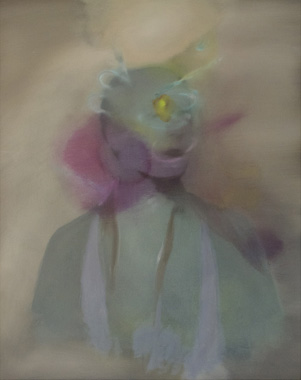
In our February 2013 Spin event, we will be visiting the New Work Scotland Programme: Conor Kelly and Calvin Laing exhibition at the Collective Gallery. Kate Gray, Director of the Collective Gallery, will join us in discussing the two artists selected for the exhibition, the New Work Scotland programme and the plans for the gallery’s move to Calton Hill in later this year.
New Work Scotland is a Collective initiative recognised as giving artists based in Scotland their first significant visual art project or commission. Through an annual open application, NWSP identifies and supports some of the most promising new practitioners working in the visual arts in Scotland, providing them with the opportunity to make new work and bring it to the attention of a wider public.
Conor Kelly graduated in 2008 from the MFA course at Glasgow School of Art and for this exhibition he has produced new series of paintings and sculptures. As part of his exhibition, Kelly will also present a ‘ready-made’ sculpture; La Tour de Travail (The Tower of Labour), named after Rodin’s ornate maquette for a monumental folly to labour.
Calvin Laing graduated with BA (Hons) in sculpture from Edinburgh College of Art in 2011. He works predominantly in video and sculpture with Laing himself, present in it. In his work Calvin is represented as the protagonist, playing an exaggerated and extended, alter-ego version of himself. He carries out performances in the public realm and the interaction with the public, often happening off camera, is an important part of the process, allowing the work to be manipulated and driven by people’s interjections.


