27 March 2025

Glasgow-based duo Walker & Bromwich work with communities or organisations to explore matters surrounding local and global issues. What’s exciting is that they create a collective journey within communities in a festival-like environment to tackle concerns. From unique giant inflatables with titles like Serpent of Capitalism, to totems that manifest positive and negative forces, their work can encapsulate humour, be sombre but always evoke hope.
We have the opportunity to explore the exhibition with Talbot Rice’s Curator James Clegg. The work of Walker & Bromwich will take us on a journey from the working-class communities of Wales to environmental scholars and Indigenous representatives for the Colombian Amazon with a stop off with anarchists in Denmark.
16 November 2006 at 6.30pm
For our next SPIN:Glasgow event, were going to go out of the galleries and into the city!
Glasgow has some fantastic pieces of public art in places throughout the city – some you might have noticed, some you might have walked by lots of times without noticing them, some youve wondered about and wanted to find out more.
One of Glasgow’s most prominent artists in this field is Stephen Hurrel. Were really pleased that Stephen has agreed to meet with us for the next SPIN:Glasgow event to talk about one particular piece of his work – The Rings in Glasgow’s Buchanan Galleries. Have a look at Stephens excellent website for an overview of his public art, gallery works and collaborations at www.hurrel-visual-arts.com
After talking with Stephen about his work, we may then visit another public art work by Douglas Gordon (who has just opened a major retrospective of his work at the National Galleries of Scotland). This work, a neon sign, is very important in that its one of the few things that the city of Glasgow owns by this artist, who is widely considered to be Scotlands most prominent contemporary artist.
Please meet at us at 6.30pm outside the entrance to Buchanan Street Galleries (the entrance which looks straight onto Sauchiehall Street).
24 July 2005
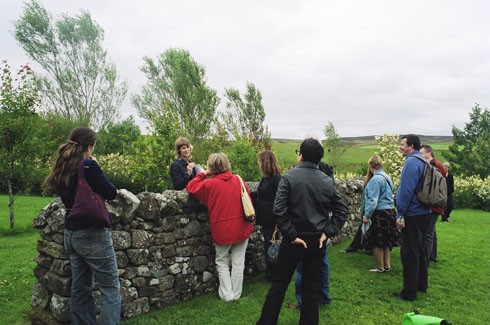
The sun is shining, the days are long; every now and then, there is the distant sound of police and protestors clashing. It is an appropriately surreal and extreme time to head to Little Sparta. The idyllic sculpture garden, surrounding a wee croft in the southern uplands of Scotland, is studded with references to the philosophical values of the French Revolution and the techniques of modern warfare. It still resonates with the noises of the Little Spartan War 1983 (the Follies War and the French War were to follow later). Finlay clashed with Strathclyde Region over its bureaucratic bungling of a rates dispute; and the sheriff officer and his men staged two raids on the Finlay’s Garden Temple. Although they were repelled by Finlay’s supporters (the Saint-Just Vigilantes) in the first battle, the sheriff and his men succeeded in seizing several works in the second onslaught. Nor was Finlay mellowed by experience – he went on to have further fights ‘on principle’ with the National Trust for Scotland and the French Ministry of Culture, as well as half of the people he ever worked with.
Ian Hamilton Finlay‘s uncompromising commitment to ‘beauty’ and classical rigour may not have won friends, but it did produce the most uniquely distinctive and challenging body of work in Scotland in the last century. Finlay is a concrete poet first and foremost, and has been a prolific collaborator with many different artists, craftspeople and poets with whom he has created an extensive collection of sculptures, prints and books. His public art works are to be found in cities all over the world and many of his works will be on display in three co-ordinated exhibitions in Edinburgh over the summer: at the Ingleby Gallery, Inverleith House and the Scottish Poetry Library. But there is no doubt that the heart and soul of Ian Hamilton Finlay’s work will always be the garden at Little Sparta.
Spin members were invited to join an exclusive bus trip to the garden, to uncover the complex threads and hedonistic delights of Finlay’s work.


