30 June 2022
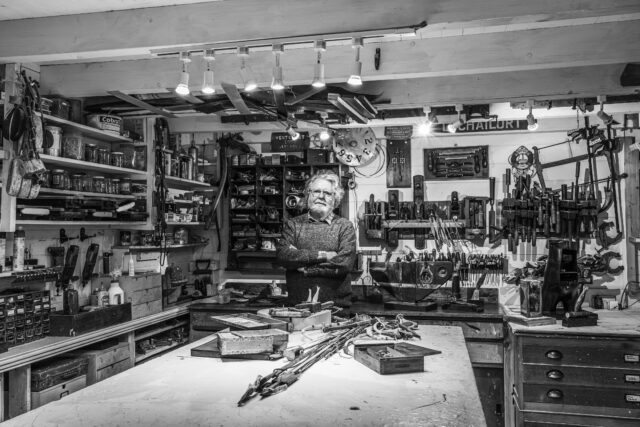
This month we will be heading along to the City Art Centre for their new exhibition Will Maclean: Points of Departure, which is also presented as part of Edinburgh Art Festival 2022. To guide us round this exhibition we will be joined by Curatorial and Conservation Manager, David Patterson, as well as the artist himself, Will Maclean.
Will Maclean (b.1941) is one of the outstanding artists of his generation. His work is anchored in the history, archaeology, and literature of the Scottish Highlands and the Highland people, as well as his family background and personal associations with the sea.
Best known for his wall constructions, this major retrospective will span almost 50 years of work and embrace every facet of his practice – his constructions, drawings, prints, sculptures, artistic collaborations, video productions and outdoor installations. Combining exquisitely hand-made pieces with found or (on occasions) mass produced objects, his work balances between simplicity and complexity and invites the viewer to linger, to admire and to ponder the universal themes which he explores.
Accompanied by a new publication, the exhibition will be drawn from public and private collections, with many of the exhibits going on public display for the first time. The exhibition promises to be a rich visual feast for anyone with an interest in Scottish art and history.
26 May 2022
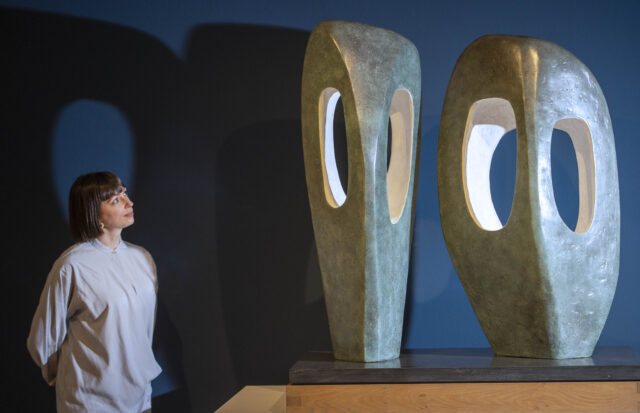
This month we will be making our way to the Scottish National Gallery of Modern Art to see Barbara Hepworth: Art & Life, where we will be joined by curator Leila Riszko.
Barbara Hepworth: Art & Life is a major retrospective, spanning the artist’s entire career charting the development of her practice, her engagement with political and societal change, and the events in her personal life which shaped her work. It features more than 120 works, lent from public and private collections, including renowned sculptures as well as rarely seen drawings and paintings.
The exhibition displays some of Hepworth’s most celebrated sculptures including the modern abstract carving that launched her career, her iconic strung sculptures, and later large-scale bronze and carved sculptures. It will also bring insight to Hepworth’s wide-ranging interests – such as dance, theatre, music, religion, politics, and science – and show how they infused her artistic practice.
Art & Life has been curated by Eleanor Clayton and organised by The Hepworth Wakefield in collaboration with the National Galleries of Scotland, and Tate St Ives.
31 March 2022
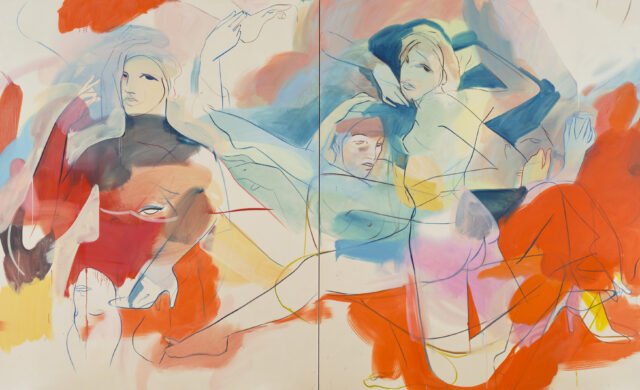
This month we are visiting New Arrivals: from Salvador Dalí to Jenny Saville at the Scottish National Gallery of Modern Art. Joining us for the evening will be Emma Gillespie. Emma has worked in a number of roles at the National Galleries of Scotland since 2014 and was appointed Assistant Curator of Modern and Contemporary Art in 2019.
New Arrivals presents a fascinating showcase of the most recent acquisitions at the Scottish National Gallery of Modern Art. Featuring over 100 works of art, many of which are being shown here for the first time since they entered the collection, and spanning 110 years of art-making, the show offers a stunning range of modern and contemporary work including painting, sculptures, films and more.
Exhibition highlights include pieces by many historical and contemporary greats: Marc Chagall (the first painting by him to join a public collection in Scotland), Damien Hirst, Wangechi Mutu, Pablo Picasso, Bridget Riley, Jenny Saville, and Alberta Whittle, amongst many others. The show also spotlights a number of significant additions to National Galleries of Scotland’s world-renowned Surrealist collection, notably several works by female Surrealists, including Leonora Carrington and Dorothea Tanning.
29 November 2018

This month we invite you to see Tremble Tremble by Jessie Jones, the Irish representation at the 2017 Venice Biennale, installed in the Talbot Rice Gallery. We will be joined by assistant curator James Clegg who will introduce the exhibition.
Approaching modern gender politics through a dramatic aesthetic, Jesse Jones’ piece evokes a multitude of associations, cultural links and triggers. For the making of this work, Jones drew from recognisable political references, such as the very title. Tremble Tremble references the 1970s Italian women’s protest of the same name, which called for wages for housework. Referring to the medieval prosecution of witches and also to the historic Repeal the 8th movement in Ireland this summer, she has created a layered and dense visual narrative which sits somewhere between theatre, film and sculpture.
The group exhibition At the Gates is shown alongside Jones’ work and consists of work by fellow women artists exploring feminism, self-empowerment and current social and political events. Often brushing up against the law, or institutions of power, these artists and their projects demonstrate the impact art can have when it becomes part of a public discussion.
26 October 2017

This month, we will be exploring the work of two contemporary artists – Graham Fagen and Douglas Gordon – who have made work in response to the poet Robert Burns (1759-1796).
First shown at the 2015 Venice Biennale, Graham Fagen’s The Slave’s Lament is centred on the 1792 Robert Burns song of the same name as well as drawing our attention to an episode in Burns’ life. In 1786, Burns books a passage to Jamaica to escape economic problems with the aim of becoming a book-keeper on a slave plantation. At the very last moment, news that his recently published first book of poems has been well received changes his mind. In 1792, he pens The Slave’s Lament, his only work that empathises with the suffering of the displaced, the trafficked and the enslaved.
The centrepiece of the installation is The Slave’s Lament, a 4-channel video work in which classical composer Sally Beamish has created an extraordinary interpretation of Burns’ work. Performed by musicians from the Scottish Ensemble, music producer Adrian Sherwood, and the reggae singer and musician Ghetto Priest, it is a chilling reminder that Burns might once have become involved in the very suffering that inspired the lament.
In the Great Hall of the Portrait Gallery stands John Flaxman’s famous 1824 marble statue of Robert Burns. Originally housed in Thomas Hamilton’s Greek revivalist Burns Monument to the south of Edinburgh’s Calton Hill, the sculpture occupies pride of place in the gallery. In a specially commissioned installation, Turner-Prize winner Douglas Gordon confronts this monument to Burns by creating a full-sized replica in black marble, smashed into pieces, lying on the floor. Gordon has long explored the divided psyche in his work and seeing Burns fallen from his pedestal, dark and flawed, the inner man is revealed.
‘With Black Burns, I don’t know if it’s a shattered portrait of a man or a portrait of a shattered man.’ Douglas Gordon.
Joining us to discuss both works will be Susanna Beaumont, a curator, mentor and advisor and founder director of doggerfisher (2000-2010).
25 May 2017

This month, we will be visiting three artists who each have a studio at WASPS on Albion Road. Artists include Louise Fraser, Jenny Pope and Carrie Fertig.
Louise Fraser’s practice incorporates drawing, printmaking and sculpture and is a response to the environment she inhabits. Her work draws people’s attention to the space they are in, the space they consume and the space they leave their imprint on.
Jenny Pope creates sculptural pieces inspired by beach-combing, collecting, bone structures and geology working with a range of materials including porcelain, limecrete and found materials. Through her work she explores the changes that happen in our internal lives and externally in the natural environment. Recently, Jenny has been working within a hospital, creating large drawings and wearable sculptures which explore personal space.
Carrie Fertig uses borosilicate glass as the main material in her practice of performance, film, installation, sound and sculpture. From the 20 May-2 July 2017, she will be exhibiting as part of Summa at the Royal Scottish Academy with an installation, sound and performance based on the physical, social and metaphysical events of death. The work she will be showing us concentrates on sound, including work from her group Torcher Chamber Arkestra, which features live music, fire, and digital manipulation of sound on glass instruments that she designs, makes, and repurposes.
This is a great opportunity to meet artists living and working in Edinburgh and to find out more about their working methods and approaches to their art-making
27 April 2017
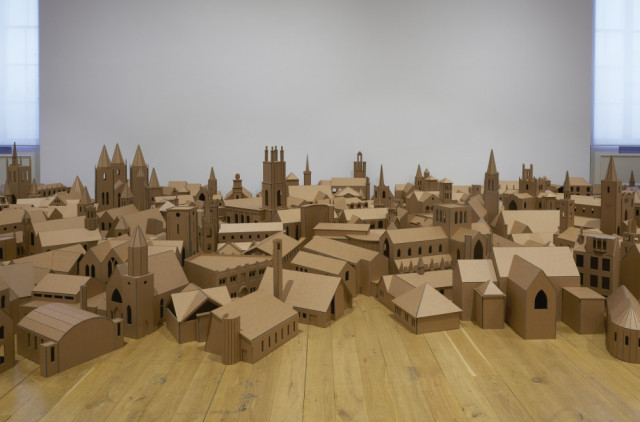
NOW is the first in a series of exhibitions which brings together contemporary art from Scotland with works by leading international artists. Over the next three years, through a series of six exhibitions, NOW will explore and celebrate the role of artists in society and the alternative ways of seeing and understanding the world through their work.
The centerpiece of the first show is Nathan Coley’s The Lamp of Sacrifice, 286 Places of Worship, Edinburgh, 2004. This iconic work features 286 sculptures which depict every place of worship listed in the 2004 edition of the Edinburgh Yellow Pages directory, offering a snapshot of the city at a particular moment in time through its places of religious meeting.
A key theme running through the exhibition is place and its relationship to time. Peter Doig’s imagined landscape is shown with Jock McFadyen’s real landscape of Carlton Hill recalled from memory. Rivane Neuenschwander’s Colheita Harvest 2013-2014 is a portrait of a London community through an installation of 365 shopping lists collected from supermarkets.
Performance Documents 1980-1987/2013 by Mona Hatoum presents rare archival material documenting the actions and performances she produced during the 1980s. And The Acrobat c.1982 by Peter Horobin, documents performances and interventions he did whilst on a month-long residency in Kassel under the persona of The Acrobat.
Joining us to discuss the works on show will be the curators of the exhibition, Lucy Askew and Julie-Ann Delaney.
30 March 2017

This month we are heading to The Fruitmarket Gallery to explore and discuss the work of Mark Wallinger. This is a two-part exhibition, shown at the Fruitmarket and the DCA in Dundee.
Mark Wallinger has been making art and exhibiting since the 1980s. You may be familiar with his piece, Ecce Homo, a marble resin life-sized statue of Jesus Christ which became the first sculpture to be mounted on the empty plinth in Trafalgar Square in 1999. His Turner Prize-winning installation of 2007, State Britain, was a painstaking recreation of Brian Haw’s anti-war peace camp in Parliament Square.
For his new exhibition, Wallinger presents his id Paintings (2015-16), a recent body of monumental paintings made entirely by the artist’s hands and black acrylic paint. Part-painting, part-performance, he used both hands simultaneously, the left mirroring the right. Also on show, will be his ‘I’ self-portrait paintings, continuing his on-going fascination with self-portraiture. In addition, there will be a selection of works from the last 10 or so years including the film Sleeper (2004).
26 January 2017
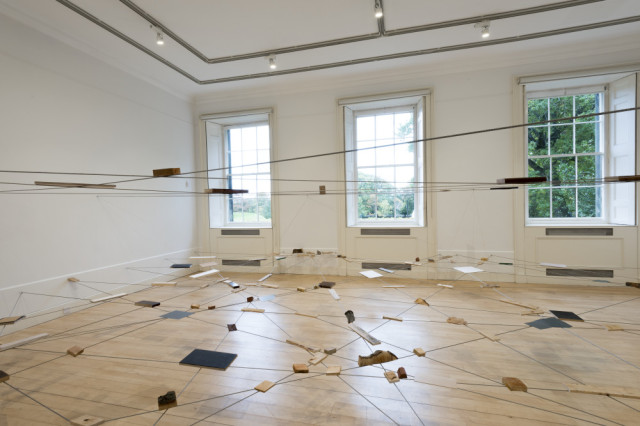
In our first event for 2017, we will be exploring the work of Karla Black (born in 1972, Alexandria, Scotland) and Kishio Suga (born in 1944, Morioka, Japan).
This is the first time that these two artists have been shown together, and neither artist was aware of each other’s work before the exhibition. What unites both Black and Suga is their use of everyday materials to create sculptural installations in response to specific spaces and locations.
Karla Black, who represented Scotland at the Venice Biennale in 2011, creates installations using traditional art materials including plaster, paint, paper and chalk in combination with everyday items including soap, eye shadow, toothpaste and cotton wool. She made most of the sculptures directly in the rooms of the gallery.
Kishio Suga is a key figure in Japanese contemporary art. In the late 1960s, he began to produce and exhibit his work as a member of the artistic group, Mona-ha (School of Things) which was formed and developed in Tokyo between 1969 and 1972. Suga also uses everyday materials including rocks, wood, wire, paraffin, stones, almost anything to hand, to create what he calls ‘situations’. The exhibition features recreations of existing works spanning his 50-year career and a new work conceived for Gallery 8. Suga represented Japan in 1978 at the Venice Biennale.
24 September 2015

For our first post-festival Spin event we will be meeting at Ingleby Gallery to talk about their major solo exhibition of new work by Charles Avery entitled The People and Things of Onomatopoeia. The exhibition was a highlight of this year’s Edinburgh Art Festival and included a temporary tree sculpture by Avery sited in Waverley Station during the festival (now relocated to the Parasol Unit gallery in London).
We will be joined by Susan Mansfield, The Scotsman’s Arts Correspondent who will join us to discuss the exhibition. In Avery’s work, the Island is located in the middle of an archipelago of innumerable constituents, and its heart is the port of Onomatopoeia. This town was once a stepping off point for pioneers and travellers, then a bustling boomtown, then a slum in a state of extended decline, and now in the fictional present, it is reborn as a regenerated city of culture and a tourist destination. This exhibition presents a new series of drawings alongside furniture, sculptures and all manner of imported artefacts that come together to describe the culture of Onomatopoeia’s inhabitants.
Elements of The Islanders project have previously been exhibited at the Scottish National Gallery of Modern Art, Parasol Unit, London and Museum Boijmans Van Beuningen, Rotterdam. In 2007 Avery represented Scotland at the 52nd Venice Biennale. The exhibition runs until 3 October 2015.


