25 September 2025
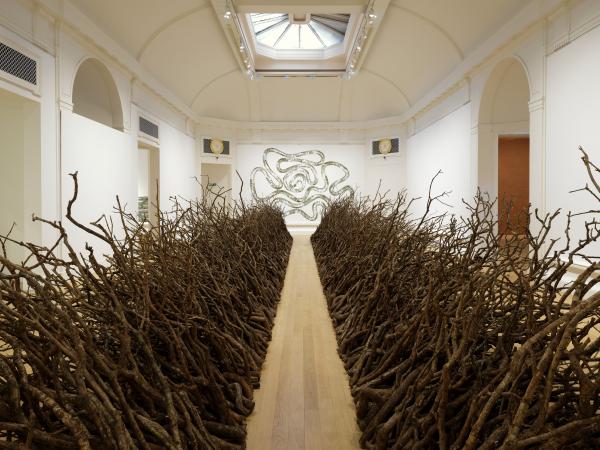
After our month off we are back to explore one of the standout exhibitions of the Edinburgh Art Festival, Andy Goldsworthy: Fifty Years. Featuring over 200 works, the show includes stunning installations made in response to the iconic Royal Scottish Academy building, as well as drawings, photographs, films, sketchbooks and archival items dating back to the mid-1970s. To provide insight into the work we will be joined by Chief Curator Patrick Elliott.
Goldsworthy is internationally recognised for his work with natural materials such as clay, stones, reeds, branches, leaves, snow and ice. For over 50 years, he has created a unique and highly influential body of work that speaks of our relationship with the land.
Andy Goldsworthy: Fifty Years has been conceived by the artist as a single immersive artwork in response to the space, materials and character of the RSA building. The interrelationship of humans and the working land is a recurrent theme in Goldsworthy’s art and in the exhibition. He often presents the land as a hard, hostile and brutal place. Fences and barriers feature prominently, in the form of rusted barbed wire stretched across a room, and a massive, cracked clay wall. As in nature, beauty and danger co-exist.
26 September 2024
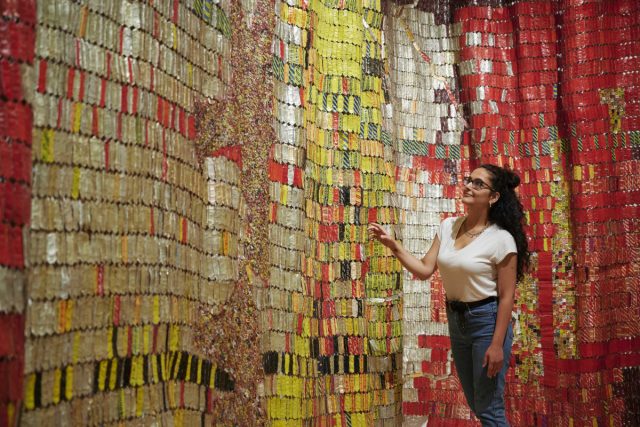
We return to Talbot Rice Gallery for their momentous showing of work by Ghanaian artist El Anatsui where we will be joined by curator James Clegg.
The most significant exploration of El Anatsui’s practice ever staged in the UK, Scottish Mission Book Depot Keta spans five decades of work and will extend to the building’s façade, turning it into an open-air gallery.
The exhibition opens with a monumental new work made specifically for Talbot Rice Gallery. It journeys through a large selection of Anatsui’s iconic large-scale sculptural wall hangings made with reclaimed metal from the bottling industry in Ghana and Nigeria (made between 2002 to 2024). This includes the ‘grandmother’ of these forms, Woman’s Cloth (2002), the first of its kind on loan from the British Museum, and a sleeping chamber in which to quietly observe Royal Slumber (2023).
26 January 2017
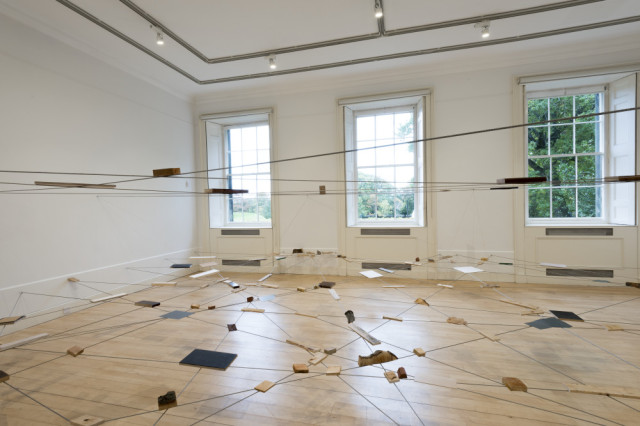
In our first event for 2017, we will be exploring the work of Karla Black (born in 1972, Alexandria, Scotland) and Kishio Suga (born in 1944, Morioka, Japan).
This is the first time that these two artists have been shown together, and neither artist was aware of each other’s work before the exhibition. What unites both Black and Suga is their use of everyday materials to create sculptural installations in response to specific spaces and locations.
Karla Black, who represented Scotland at the Venice Biennale in 2011, creates installations using traditional art materials including plaster, paint, paper and chalk in combination with everyday items including soap, eye shadow, toothpaste and cotton wool. She made most of the sculptures directly in the rooms of the gallery.
Kishio Suga is a key figure in Japanese contemporary art. In the late 1960s, he began to produce and exhibit his work as a member of the artistic group, Mona-ha (School of Things) which was formed and developed in Tokyo between 1969 and 1972. Suga also uses everyday materials including rocks, wood, wire, paraffin, stones, almost anything to hand, to create what he calls ‘situations’. The exhibition features recreations of existing works spanning his 50-year career and a new work conceived for Gallery 8. Suga represented Japan in 1978 at the Venice Biennale.
21 September 2011 at 6.30pm
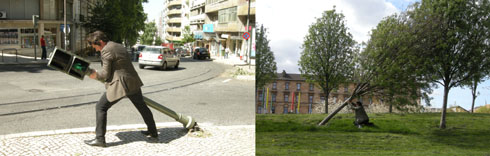
Peter McCaughey is an artist based in Glasgow, who works internationally with a practice focused on the local. He describes his practice as people-centred, ideas-based work. His research is currently focused on landscape and memory, ritual, exchange, and how art and the artist might operate in relation to people in the public realm. His work is often site-related and time-specific. Sometimes the work is transient, involving film, video, outdoor projection, sound and light and storytelling; on other occasions the work is permanent, using more traditional materials and processes to explore experiential and conceptual ideas.
Through his recent work, he has been testing the contested role of the artist in the process of regenerating place. He regularly collaborates with artists, architects, engineers, writers, and community activists. To do this as effectively as possible, he established Wave, a small organisation set up five years ago to support and direct a team approach to large urban regeneration arts projects, public art commissions and various levels of consultation.
Currently, Peter is beginning the second half of a one-year residency at the Glasgow Housing Association as their Creative Advisor. He has also started his first project as an art commissioner for the urban regeneration company, Clyde Gateway.
Peter hopes to use Trongate 103 as both a traditional studio for testing and developing ideas, and a meeting place to test some of the models he is currently trying to develop that aim to bridge the lack of opportunities for artists working in the city.
20 October 2010 at 6.30pm
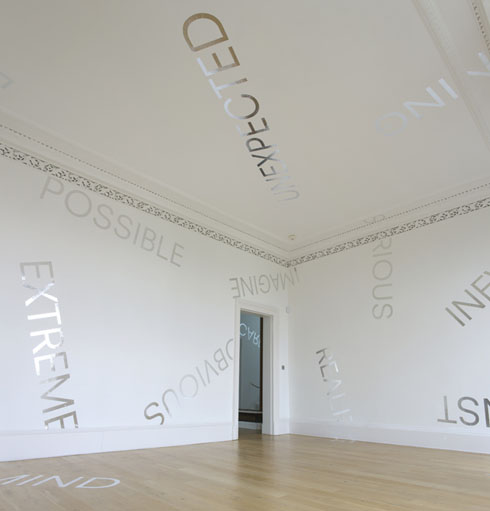
A visit to the acclaimed New York artist Robert Barry’s exhibition, Words and Music at the Common Guild.
This exhibition comprises a new installation conceived specially for The Common Guild by one of the most influential American artists associated with the emergence of conceptual art in the late 1960 and early 1970s. Robert Barry was a pioneer of conceptual art, abandoning painting in 1967 to produce site-specific installations, many of which were almost invisible to the viewer. These installations and actions relied on language to indicate their existence, shifting the presentation and reception of the work from image to text.
Since the early 1970s, language, or perhaps more correctly, words, have been central to Barry’s practice, which has since included typewriter drawings, wall pieces, slide projections and films as well as often cited actions such as gas releases and telepathic pieces. Barry is now perhaps best known for his large-scale text installations known as word spaces, which cast a selection of words in a given space from an ongoing and ever-changing collection.
Applied directly to the walls, windows and floors of the gallery, the words surround the viewer, reasserting the importance of the viewer at the heart of the art experience. As Barry explains, ‘Instead of trying to use text to convey an idea or meaning, I became interested in the individual power of the word to convey emotions or feelings.’
Although utterly conceptual in origin, Robert Barry’s work is essentially experiential. This rare opportunity to see his work brings the physical space between the words, the gallery and the viewer into focus.
27 May 2010 at 6pm
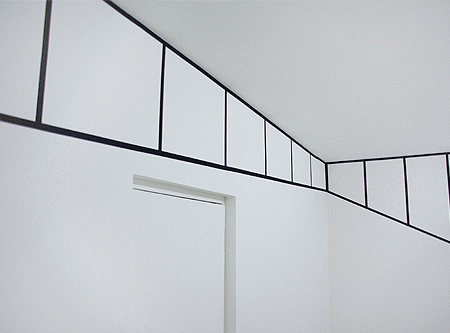
This month we will be visiting Sleeper to see the work of Switzerland-based artist Daniel Gottin. For the past twenty years, Gottin has focused on making temporary, site-specific interventions that examine the subjective nature of perception. His installations, always consisting of common industrial materials, such as tape, carpet, and paint, playfully respond to the specific characteristics of an architectural site and activate the viewers relationship to it.
Gottin has made the work in direct response to Sleeper’s one-room exhibition space, which is located in the basement of the offices of Reiach and Hall Architects. Sleeper was founded in 2000 by visual artist Alan Johnston and architect Neil Gillespie, to bring together a rich diversity of national and international art and as a way to continue a dialogue between contemporary art and architecture. Previous artists have included Bruce Nauman, Lesley Foxcrot, Charles Avery, Douglas Gordon, Alan Charlton, Martina Klein, Adam Barker-Mill, Thomas A Clark and Roger Ackling.
We will have the pleasure of the company of Neil Gillespie, Director of Reiach and Hall Architects, who will join us in discussions about the influence of contemporary art on their architecture and about their collaborations with the artists.
Neil Gillespie’s architectural projects include The Pier Arts Centre, Stromness which was winner of the 2007 RIAS Doolan Building of the Year Scotland Award; the competition design for Dunfermline Museum and Art Gallery; and the Beatson Institute, University of Glasgow. Gillespie is also a tutor at the Architecture Department of Edinburgh College of Art.


