Tag Archives: text

Shelly Nadashi

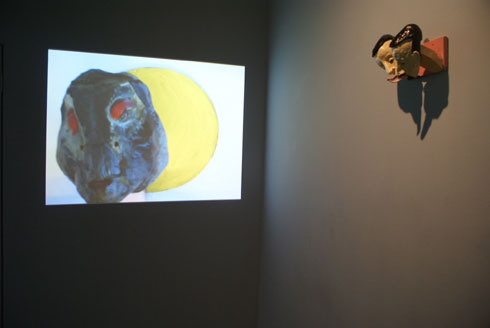
Acclaimed emerging artist Shelly Nadashi will personally screen her short films, show slides and talk to us about her emerging practice.

Nadashi is a multi-disciplinary artist based in Glasgow, having graduated from The School for Visual Theatre in Jerusalem and from the MFA programme at the Glasgow School of Art. Her practice encompasses a variety of media such as performance, video, puppetry, text, sound and object-making.

Nadashi’s work is simultaneously autobiographical and surreal, presenting narratives that examine the way in which personal situations are constructed from broader social contexts. This strategy emotionally engages and entertains the audience whilst concurrently creating a space for them to reflect on the wider themes inherent in these narratives, such as voyeurism, social pressure to conform and the effect of our immediate environment on our mental state. A sophisticated comic exaggeration in both her speech and gesture accentuate the pathos of her situation but also contradicts the melodrama by undercutting the seriousness of whats at stake.

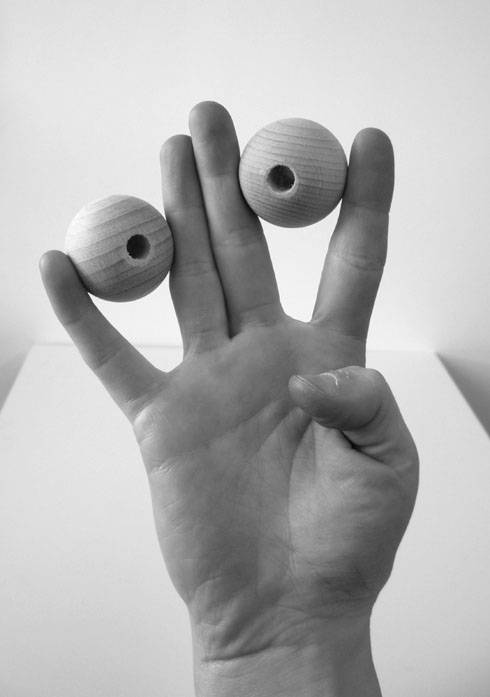
Nadashi has sustained interest in working with inanimate objects. This performative mechanism mimics the relationship between the puppet and puppeteer, setting up a symbolic, fetishistic (mystical and sexual) rapport with these objects and attributing to them particular powers. This technique allows a forensic examination of lifes intimate moments that is incisive but dreamlike. The objects exist as documents of a performance but are also imbued with a votive quality independent of the text.

Nadashi has exhibited and performed internationally, participated in numerous group exhibitions, and produced an award-winning film. She is currently working towards two solo exhibitions.
Robert Barry

A visit to the acclaimed New York artist Robert Barry’s exhibition, Words and Music at the Common Guild.

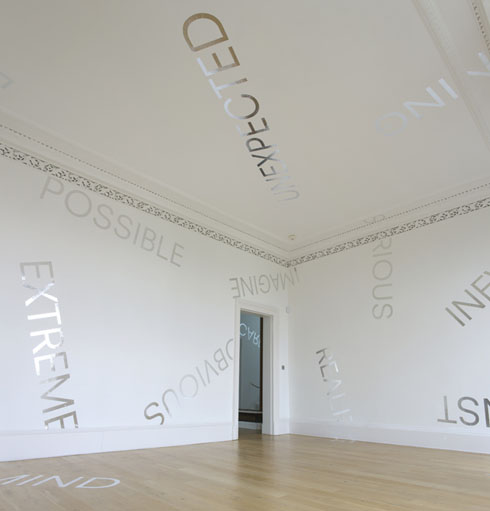
This exhibition comprises a new installation conceived specially for The Common Guild by one of the most influential American artists associated with the emergence of conceptual art in the late 1960 and early 1970s. Robert Barry was a pioneer of conceptual art, abandoning painting in 1967 to produce site-specific installations, many of which were almost invisible to the viewer. These installations and actions relied on language to indicate their existence, shifting the presentation and reception of the work from image to text.

Since the early 1970s, language, or perhaps more correctly, words, have been central to Barry’s practice, which has since included typewriter drawings, wall pieces, slide projections and films as well as often cited actions such as gas releases and telepathic pieces. Barry is now perhaps best known for his large-scale text installations known as word spaces, which cast a selection of words in a given space from an ongoing and ever-changing collection.

Applied directly to the walls, windows and floors of the gallery, the words surround the viewer, reasserting the importance of the viewer at the heart of the art experience. As Barry explains, ‘Instead of trying to use text to convey an idea or meaning, I became interested in the individual power of the word to convey emotions or feelings.’

Although utterly conceptual in origin, Robert Barry’s work is essentially experiential. This rare opportunity to see his work brings the physical space between the words, the gallery and the viewer into focus.

Martin Creed – Down Over Up

This month, we will be discussing Martin Creed’s major exhibition of new work, Down Over Up. One of Britain’s most highly-regarded and popular artists, he is known for installations such as his 2001 Turner Prize work, No. 227, The Lights Going On and Off and in 2008, No. 850, in which volunteer runners sprinted across the Tate Britain gallery every 30 seconds.

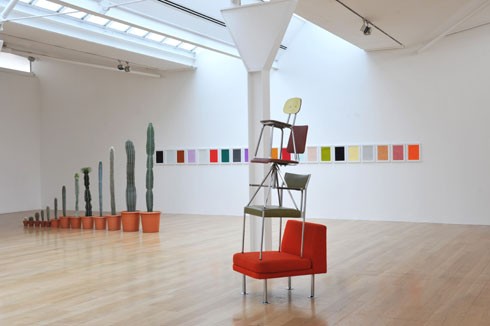
Renowned for his straightforward approach to making art and his deft economy of means, Creed has produced sculptures, installations, drawings, films, performances, music and text, each of which has found its inspiration in the objects and activities of everyday life. Always in search of the essential nature of things, Creed uses the simplest materials to create a world in which reality appears transformed by conceptual rules, as well as by the unexpected breaking of those rules.

‘I want to make things. Im not sure why, but I think its got something to do with other people. I think I want to try to communicate with other people, because I want to say “hello”, because I want to express myself, and because I want to be loved.’ Martin Creed.

Ciara Philips

Utilizing a range of media including painting, knitting and screen-printing, Ciara Phillips combines two and three-dimensional works to create installations that draw upon a diverse range of interests – from Medieval woodcuts to Memphis design. Phillips’ practice has focused on drawing parallels between various historical periods and traditions by aligning them with observations of her immediate surroundings. This, coupled with her long-standing interest in combining text and image, is reflected in her current works, which hint at a tongue-in-cheek humour whilst also soliciting serious reflection.

Phillips has developed a new body of work that investigates the relationship of the female body to language. A development of recent work in which the alphabet has been employed as a framework from which to draw formal and conceptual associations, this exhibition combines silkscreen prints, murals and sculptural elements to create an installation that invites the viewer to consider language in its conceptual, physical and material manifestations. Using the body as a basis from which to make letters, Phillips draws upon the long-standing tradition of the human alphabet and seeks to propose new arrangements that offer playful possibilities for a personal interpretation of letters and language. The work in this exhibition was developed during the summer of 2009 whilst Phillips was on residency at Cove Park, and subsequently at the Glasgow Print Studios. An essay accompanies this exhibition from writer Ellie Herring.

Born in Ottawa, Canada, based in Glasgow, Phillips studied Fine Art at Queens University, Kingston (BFA 2000) and Glasgow School of Art (MFA 2004). Recent exhibitions include: Vowelled, Glasgow Project Room (2007); Scottish Collective, with Market Gallery at the Royal Scottish Academy, Edinburgh (2006); and The Clamour of Ornament, Glasgow International Festival of Contemporary Art 2006.

The Islanders: An Introduction by Charles Avery

To start the year, we will be visiting the Gallery of Modern Art to discuss The Islanders: An Introduction by Charles Avery, a key figure in a new generation of Scottish artists.

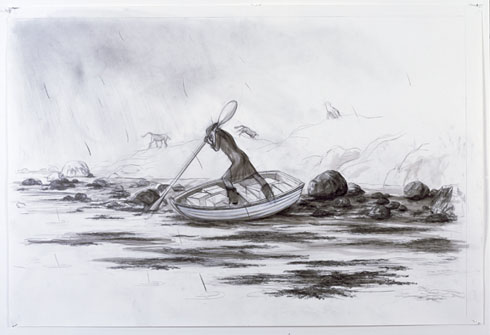
For the past four years, Charles Avery has created texts, drawings, installations and sculptures which describe the topology and cosmology of an imaginary island, whose every feature embodies a philosophical proposition, problem or solution. Avery’s mapping of the island focuses on absurd details from mysterious landscapes, such as the Eternal Forest to strange gods and the inhabitants addiction to gin-pickled eggs. The island’s wildlife is also on show represented in the form of large taxidermy sculpture.

‘The Island is not a parallel world, its part of this world, therefore it is a fiction. I use the word fiction very broadly. History is a fiction, art history is fiction. Maybe reality is the biggest fiction of all!’ Charles Avery.

Ilana Halperin – Towards Heilprin Land

This month, we will visit doggerfisher to see the work of Ilana Halperin.

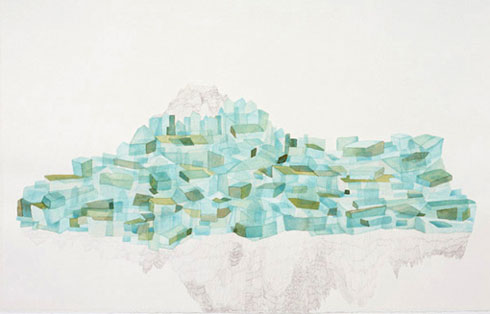
In Towards Heilprin Land, volcanic stories gathered from the Smithsonian Institution in the USA, collide with polar encounters from a fragile landmass in the far north. The nature of love is explained by a geoscientist; volcanologists talk about their long-term relationships with volcanoes from around the world and an eco-expedition aboard a ship to north-east Greenland is charted through a new series of drawings, photographs, watercolours, etchings, videos and text.

Ilana Halperin has a curiosity about the physical world. She has an interest in fathoming out the nature of geological change and the movement of time in relationship to her own life, encounters and travels. Projects often involve travelling to remote locations and performing actions or poetic gestures.

Joining us will be Ilana Halperin to discuss Towards Heilprin Land and to talk about her fascination with the relationship between geological phenomena and daily life. She will also give a performance on the evening – a very special treat for our Spin members!

Douglas Gordon: Superhumanatural

‘I provide the board, the pieces and the dice, but you are the ones that have to play.

Douglas Gordon

We will be visiting the much-anticipated retrospective exhibition by Douglas Gordon, one of Scotland’s most celebrated contemporary artists. And it doesnt disappoint.

The Royal Scottish Academy Building has been transformed beyond recognition with specially constructed blacked-out spaces, TV monitors and installations where the familiar becomes unfamiliar. Superhumanatural is Gordon’s first retrospective exhibition to be held in Scotland and features key works including 24 Hour Psycho (1993), Through a Looking Glass (1999) and 30 Seconds Text (1996).

Born in Glasgow in 1966, Douglas Gordon was among a number of Glasgow-based artists who embraced a more conceptually-orientated art in the 1990s. His deployment of pre-existing material, most notably in his use of Hitchcock’s iconic film in his work 24 Hour Psycho, attracted particular attention. He won the Turner Prize in 1996, the Premio 2000 at the Venice Biennale in 1997 and the Hugo Boss Prize at the Guggenheim Museum, New York in 1998. Earlier this year, he had a mid-career survey exhibition at the Museum of Modern Art in New York.

Working in video, film, photography, audio and text-based works, he explores themes of trust, guilt, confession, deception and doubling. Many of his works are based on dichotomies – good and evil, life and death, birth and death, perception and memory and seduction and violence.

This is a great opportunity to see a major exhibition of his work. We will be joined by Keith Hartley, curator of the exhibition and Chief Curator and Deputy to the Director at the Scottish National Gallery of Modern Art. Keith, who was the exhibition curator, has been working on the show for a few years and will be able to provide us with a fascinating insight into the works and the man himself.

Incommunicado

As promised, here is some more information about the upcoming Spin event in this impressive exhibition from the Hayward Gallery in London which opened here at the weekend. The Hayward blurb for the show is very illuminating, so I thought I would reproduce it here:

‘The desire to communicate can be a powerful motive behind the production of art, but it is the fallibility of communication that provides the subject for this exhibition.’

Curated by Margot Heller, Director of South London Gallery, Incommunicado brings together contemporary international film, video, photography, sculpture, drawing and text-based work to explore the manifestations and consequences of communication going wrong. The show examines personal misunderstandings, cultural and political clashes and linguistic and expressive limitations.

The importance of language in this context is introduced through work by Samuel Beckett, simultaneously signalling the writers influence on younger generations of visual artists. Central to the exhibition is Comedie (1966), a recently re-discovered film made in collaboration with Marin Karmitz, which reveals the poetic and absurd results of separating language from meaning. Other artists include: Pavel Buchler, Phil Coy, Omer Fast, Angus Fairhurst, Mona Hatoum, Christian Marclay, Bruce Nauman, Hirsch Perlman, Smith/Stewart, Erika Tan, Lawrence Weiner, Francesca Woodman and Chen Zhen.

You can probably tell from this that there will be elements of humour, absurdism, and poetry as well as a stimulating underlying theme to think about, and so it is highly appropriate (and gratifying) that we will have the artist John Beagles to help us negotiate it all! As well as being a lecturer in the Centre for Visual and Cultural Studies at Edinburgh College of Art, John works alongside Graham Ramsay in their art practice as the video/performance/installation art duo Beagles and Ramsay. They have had solo shows all over the place including Canada, Australia and the Netherlands, and are a very popular part of the contemporary scene in Scotland. You might have seen them last year at Zenomap, Scotland’s contribution to the Venice Biennale, the Stills Gallery or at the Collective Gallery.